
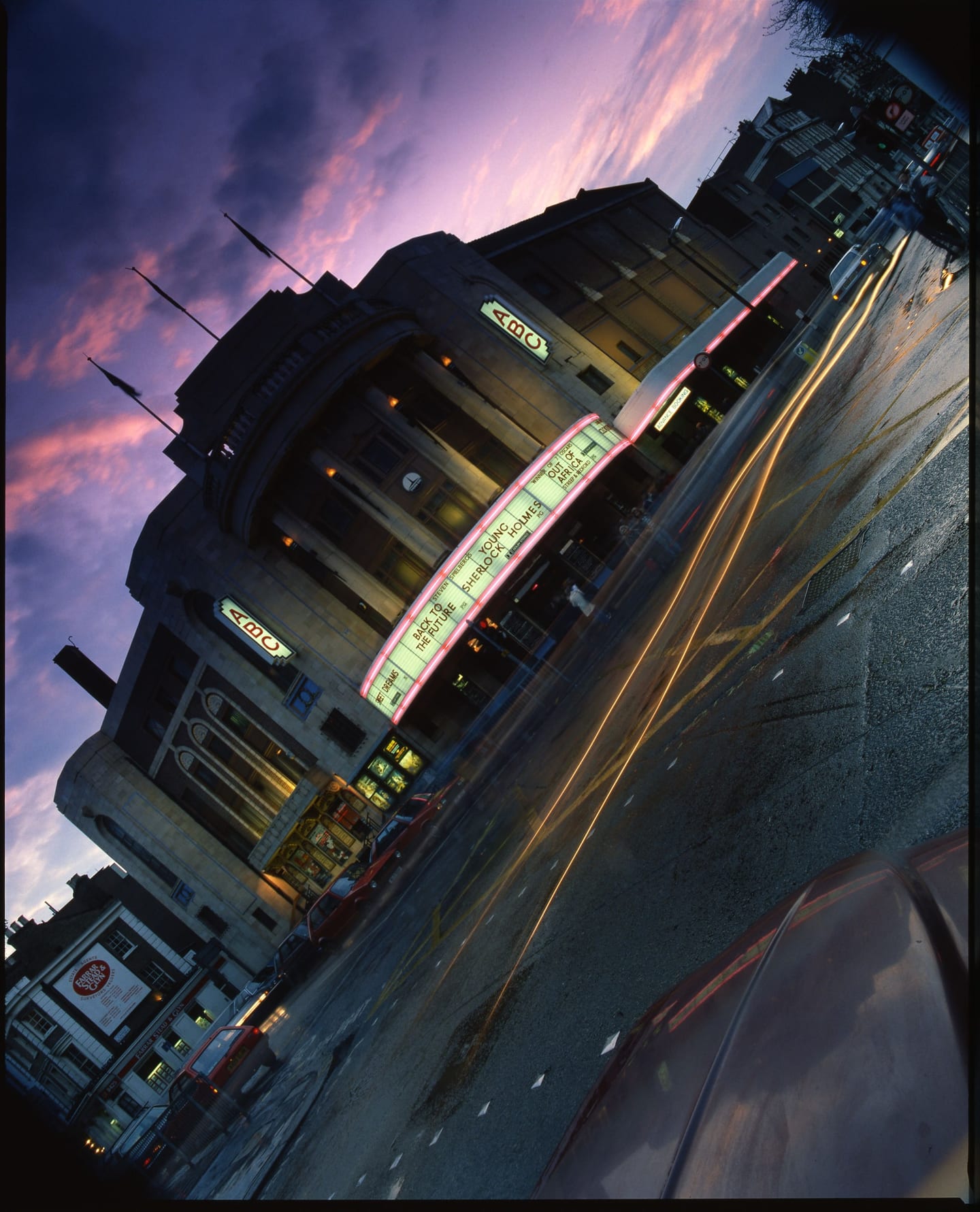
Same cameras, same film, same decades, and two utterly different pavements. What separates London's street photography from New York's is not talent but distance, humour and the angle of the sun.
New York photographers walked into the crowd; London photographers waited at its edge, and each city's pictures still carry that half step of difference.
British street photography of the 1960s and 1970s and its New York counterpart were made with the same small cameras and the same fast black-and-white film, often by people who knew one another. Put the pictures side by side and they could not be mistaken. New York's are close, loud and a little dangerous. London's stand back half a pace and wait for something faintly absurd to happen.
Most comparisons stop at national character: Americans are brash, the English are reserved. We think the differences are more concrete than that and can be named. They come down to three things a photographer cannot choose: how near the city lets you get, what the city finds funny, and where the sun is. This piece takes each in turn, with the documented facts about who did what and when.
Who defined street photography in each city?
In New York the reference point is an exhibition. New Documents ran at the Museum of Modern Art from 28 February to 7 May 1967 and showed 94 black-and-white photographs: 32 by Diane Arbus, 30 by Lee Friedlander and 32 by Garry Winogrand. The curator, John Szarkowski, wrote that these photographers had turned documentary technique to personal ends: "Their aim has been not to reform life, but to know it."
Winogrand, born in the city in 1928, became the type of the New York street photographer. Szarkowski called him the central photographer of his generation. He won Guggenheim fellowships in 1964, 1969 and 1979, and photographed at such a rate that when he died in 1984 he left about 2,500 rolls undeveloped, 6,500 developed but not proofed, and nearly 300,000 unedited images in total. Around him worked Joel Meyerowitz, who left a job as an advertising art director in 1962 after watching Robert Frank at work, and the older Helen Levitt, who had been photographing children and neighbours on the city's streets since the 1930s.
London had no equivalent institution and no equivalent moment. Roger Mayne, who photographed the children and teenagers of Southam Street in Notting Dale between 1956 and 1961, described himself as working "very much in an aesthetic vacuum", unable to find a coherent British tradition to join. His pictures reached the public through magazines and book jackets: the novelist Colin MacInnes asked him for the cover photograph of Absolute Beginners in 1959. The Victoria and Albert Museum's retrospective came in 1986, a quarter of a century after the work was finished.
The second key figure is the bridge between the two cities. Tony Ray-Jones, born in Somerset in 1941, won a scholarship to Yale at nineteen, attended Alexey Brodovitch's Design Lab, held in Richard Avedon's Manhattan studio, and got to know the New York street photographers, Meyerowitz among them. He came home in late 1965 and applied what he had learned to the English at leisure. His exhibition The English Seen was shown at the Institute of Contemporary Arts in 1969. He died of leukaemia in 1972, aged 30. A Day Off: An English Journal was published two years later.
How do the two cities compare at a glance?
| London | New York | |
|---|---|---|
| Founding documents | Roger Mayne's Southam Street, 1956 to 1961; Tony Ray-Jones, The English Seen, ICA, 1969 | New Documents, MoMA, 1967 |
| Institutional support at the time | Magazines, book jackets, the ICA | MoMA exhibitions and publications, Guggenheim fellowships |
| Typical distance | A few paces back; the scene, not the face | Arm's length; the face in the crowd |
| Characteristic subject | Ritual, leisure, class, the seaside, the queue | Fifth Avenue crowds, parades, press events, the zoo |
| Humour | Social comedy and embarrassment | Collision, coincidence, the visual pun |
| Light | Soft, overcast, low contrast | Hard, directional, deep shadow between tall buildings |
| Early colour | Seldom seen in exhibited work of the period | Levitt from 1959; Meyerowitz from 1962 |
The rows on distance, subject and humour are our reading of the pictures, not a matter of record, and exceptions are easy to find. They are offered as a way of looking.
Why does New York work feel closer?
Partly density. A Midtown pavement at lunchtime puts a photographer inside a moving crowd whether he likes it or not, and the crowd is too busy to object. Winogrand's best-known street pictures are made from within that flow: figures cut by the frame edge, the horizon tilted, three separate dramas in one rectangle.
Partly licence. New Documents gave the confrontational picture a theory. If the aim was to know life and not to reform it, the photographer owed the subject no flattery and no social purpose. That freed the New Yorkers from the manners of humanist reportage, and their subjects' startled or hostile glances became part of the content.
London offered neither condition in the same degree. Its pavements were emptier and its people more alert to being looked at. Mayne's solution was time: he returned to the same street for five years until he was part of the furniture. Ray-Jones's was patience of another kind, standing at the edge of a beauty contest or a beach until the frame filled with unrelated small events. Both methods produce a picture seen from just outside the action. The half step back is not timidity. It is what the city required.
What did each city find funny?
New York humour in these pictures is physical and coincidental: a gesture that rhymes with a shop sign, a dog that looks like its owner, a politician upstaged by a bystander. Winogrand's first book, The Animals (1969), found its comedy at the Bronx Zoo and the Coney Island Aquarium, among people looking at creatures looking at people. Public Relations (1977), drawn from public events photographed between 1969 and 1976, did the same for press conferences and demonstrations.
London humour is social. Ray-Jones's subject was the English engaged in organised enjoyment, and the joke is nearly always about the gap between the occasion and the people enduring it: deckchairs in the wrong weather, formal dress in a field. Nobody collides with anybody. They sit a careful distance apart and decline to notice one another, which is funnier.
The difference has consequences for how the pictures are read now. New York street photographs tend to work one at a time, as single jolts. London ones gain from being seen in sets, because the comedy is cumulative, and from captions, because the viewer needs to know that this is Glyndebourne or Margate.
How much is down to the light?
More than is usually admitted. London sits at about 51 degrees north and New York at about 41, roughly the latitude of Madrid. The sun stands higher over Manhattan for most of the year, the skies are more often clear, and the avenues run between tall buildings that turn daylight into alternating slabs of glare and shadow. On black-and-white film that gives hard edges, deep blacks and figures picked out as if by a spotlight.
London's light is lower and more often filtered by cloud. The tonal range is narrower, shadows open up, and faces are evenly lit. The same film that looks graphic in New York looks gentle in Kensington. Photographers could and did push the contrast in printing, but the raw material was different, and a style grew out of it: New York pictures built on shape, London pictures built on detail.
It also shaped the move to colour. Hard light and saturated signage reward colour film, and New York had both. Levitt was photographing the city in colour with Guggenheim support in 1959 and 1960, and Meyerowitz carried colour on the street from 1962 before committing to it for good in 1972. The fuller story is in our piece on the pioneers of colour photography.
Where can you see the work today?
For New York, the Museum of Modern Art published Winogrand's books and remains the obvious starting point. For London, the Victoria and Albert Museum has shown Mayne, and the published books of both Mayne and Ray-Jones are the most direct way in. Our index of photographers gathers the names, and the photography directory maps galleries, museums and festivals in both cities.
Beyond the famous names lies a much larger body of street-level pictures that were never made as street photography: magazine assignments, location recces, and personal frames taken on the way to a job. Those are the pictures that tell you what a particular pavement looked like in a particular year, and most of them are still in photographers' files.
What does the Robert Harper archive hold of London streets?
Robert Harper moved from Scotland to London to study photography and built his career there. The archive's inventory lists a folder of street scenes, 101 frames, catalogued as the Chelsea Arts Club in the 1970s, New Bond Street in 1976 and a fire in the 1960s. They form the Chelsea Arts Club and New Bond Street collection, and we have written about the 1976 group in 1970s London photographs: New Bond Street, 1976.
We make no claim that these belong to the tradition described above. They are a working photographer's pictures of his own city, not yet scanned or captioned frame by frame, and they will be described properly when they have been. The wider London collection gathers what else the inventory records, including a corporate folder that lists rush hour on London Bridge.
When street pictures are scanned, the first job is to keep them in sequence, because the frames either side of a good one explain it. The free contact sheet maker lays a set of scans out in order for exactly that purpose.
Picture researchers and publishers working on London in the 1960s and 1970s can enquire through the picture agencies page.
Frequently asked questions
Who were the main British street photographers of the 1960s and 1970s?
Roger Mayne, whose Southam Street pictures date from 1956 to 1961, and Tony Ray-Jones, who photographed the English at leisure from late 1965 until his death in 1972, are the two most often cited. Around them worked many photographers better described as documentary or magazine photographers, since Britain had no gallery system for street work at the time.
How did New York street photography differ from London's?
New York work of the period is typically closer, faster and more confrontational, made in dense crowds under hard light between tall buildings. London work tends to keep a little more distance and to look for social comedy: ritual, class and embarrassment. These are tendencies, not rules, and Tony Ray-Jones deliberately brought the New York method home.
What was the New Documents exhibition?
New Documents was an exhibition curated by John Szarkowski at the Museum of Modern Art, New York, from 28 February to 7 May 1967. It presented 94 black-and-white photographs by Diane Arbus, Lee Friedlander and Garry Winogrand, and argued that a new generation was using documentary methods for personal ends.
Did street photographers in the 1960s shoot in colour?
Some did, though little of it was exhibited at the time. Helen Levitt photographed New York in colour with Guggenheim grants in 1959 and 1960, and Joel Meyerowitz used colour film on the street from 1962. Black and white remained the norm because it was cheaper, faster, easier to print and more readily accepted by museums.
Where can I see 1960s and 1970s street photography of London?
Museum photography collections, national and city museums, picture libraries and photographers' own archives all hold it. The Victoria and Albert Museum staged a retrospective of Roger Mayne's Southam Street work in 1986. Archive.London's photography directory maps galleries and museums, and its London collection lists what the Robert Harper archive records.
Sources
- Wikipedia, New Documents (MoMA, 28 February to 7 May 1967; 94 photographs; Szarkowski's wall text)
- Wikipedia, Tony Ray-Jones (Yale, Brodovitch Design Lab, return in late 1965, ICA 1969, A Day Off 1974)
- Wikipedia, Roger Mayne (Southam Street 1956 to 1961, ICA 1956, V&A 1986)
- Wikipedia, Garry Winogrand (books, Guggenheim fellowships, unedited work at his death)
- Wikipedia, Joel Meyerowitz (colour on the street from 1962; permanent adoption in 1972)
- Wikipedia, Helen Levitt (colour work 1959 to 1960; MoMA slide projection 1974)
Published by Archive.London. Corrections are welcome under our editorial policy.