
What you would be licensing
A single body of work. Robert Harper trained in the Condé Nast studios in London, where he assisted David Bailey, Helmut Newton and Lester Bookbinder, and was a freelance assistant to Terence Donovan, Tony McGee, Alan Randall and Alex Chatelain, and then worked for some thirty-five years as an editorial and commercial photographer from his own London studio. He contributed regularly to Elle and The Telegraph Magazine for more than fifteen years, and his clients included De Beers, Harrods, Selfridges, Boots, Heinz, Diageo, the BBC, CBS Records and Montblanc. The biography gives the full account.
The archive he left is unusual for a data buyer in four ways.
One author. Every photograph has the same creator, so the collection is consistent in craft and traceable in origin. It is not an aggregation of contributor uploads.
One counterparty. 825 Ventures Ltd is the owner and rights holder. A licence is one contract with one company, set out in our rights and stewardship statement and image licensing terms.
Camera originals. The digital photographs are held as Nikon raw files as well as TIFFs and JPEGs. The analogue photographs are first-generation film, mainly 6 × 7 transparencies.
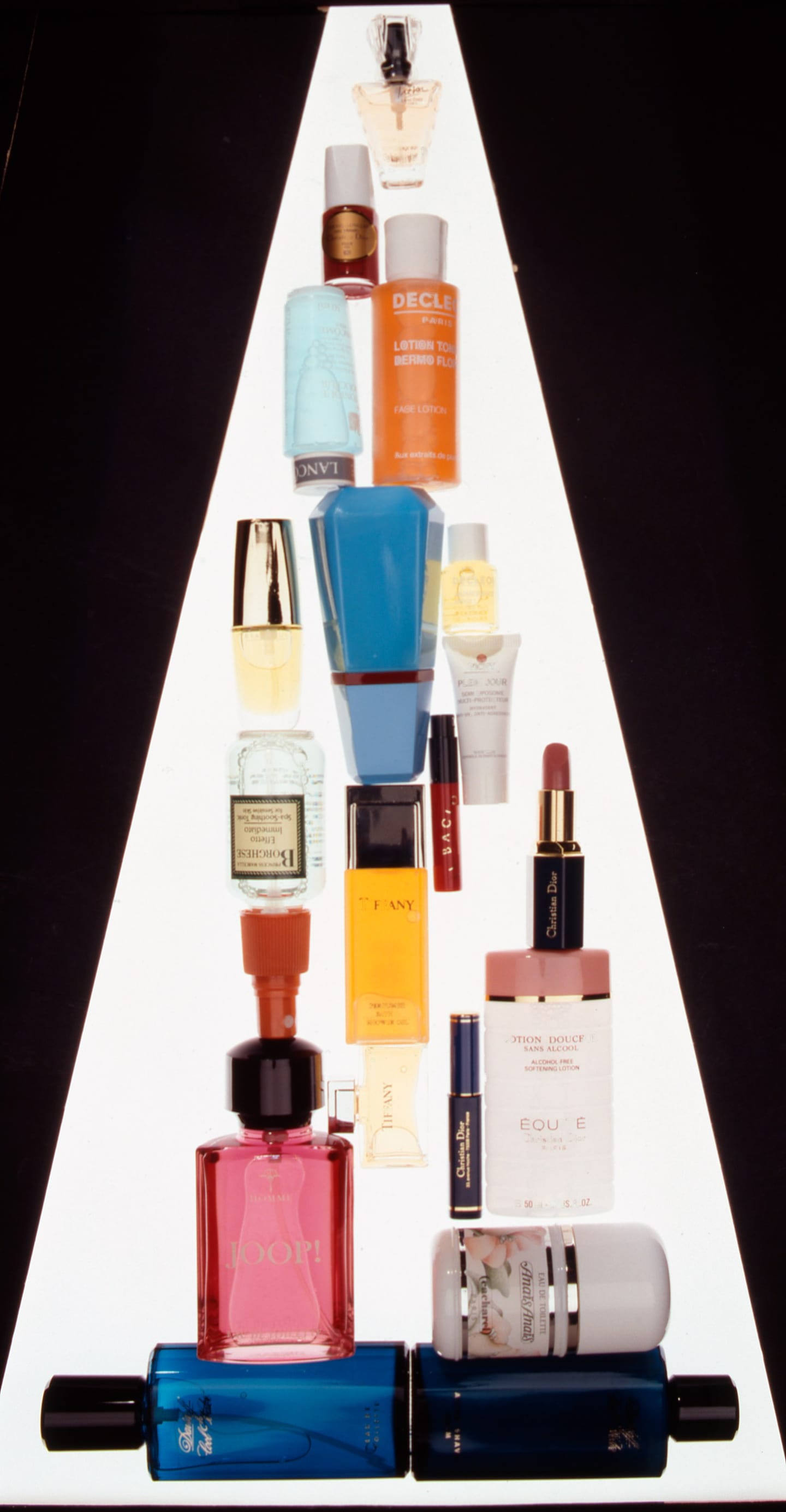
Studio depth. A large share of the catalogue is controlled studio photography of objects: jewellery, watches, fragrance, cosmetics, footwear, handbags, food, drink, tableware, toys and technology. These are professionally lit photographs of real products against considered backgrounds, the kind of imagery that product and e-commerce models are built around.
The collection in numbers
| Unique photographs | 95,487 |
|---|---|
| Digital photographs | 42,803, held as Nikon NEF raw files, TIFFs and JPEGs |
| Analogue originals | 52,684, largely not yet scanned |
| Frames including variants and duplicates | 177,143 |
| Inventory | 503 folders, published in full with shot and frame counts |
| Described collections | 330, in 24 principal categories |
| Analogue formats | Mainly 6 × 7 colour transparency film; also black-and-white negatives, contact sheets, larger-format film, 35mm slides and 4,005 Polaroid prints |
| Period | 1960s and 1970s material through to the digital era |
| Rights holder | 825 Ventures Ltd, London |
These figures come from the archive's 2025 inventory, which is published in full as a searchable table and CSV. Its lines add up exactly to the totals above; they have not been checked frame by frame against the physical material. The archive in facts page explains how the counts work.
What it is suited to
We would rather describe fit than promise results. On the evidence of the catalogue, the collection suits:
- Fine-tuning and domain adaptation for product, still-life, fashion and beauty imagery.
- Evaluation sets where a model's developers need held-out images with a documented source.
- Style and period studies: late twentieth-century editorial lighting, colour and composition, originated on film.
- Retrieval and captioning research on a collection that already has written collection-level descriptions.
- Material culture: early mobile telephones, hi-fi, credit cards, packaging, toys and interiors as they looked at the time.
It is not a web-scale corpus, and it is not a substitute for one.
What we do not claim
- We do not say the photographs are cleared for every use. Portraits, performers, branded products and magazine pages are reviewed case by case and can be left out of a licensed set.
- We do not say the whole archive is available as files. More than half is still on film.
- We do not claim item-level keywords for every image. The catalogue is described at collection level today; item-level captioning is part of the digitisation programme.
- We do not quote benchmark results. A sample lets your team judge the material directly.
How a licence is agreed
- You tell us the purpose. Model type, training or evaluation, internal or commercial deployment, territory and term.
- We define a subset. By category, format, period or subject, drawn from the catalogue.
- Rights review. We check the subset for identifiable people, trade marks, third-party works and any restrictions, and agree exclusions.
- Sample under NDA. A representative set from already-digital, reviewed material.
- Licence and delivery. A written licence stating permitted uses, exclusivity, term, attribution and deletion terms; files delivered with metadata.
Licence shapes we will discuss
- Non-exclusive licence to a defined subset for training or fine-tuning.
- Time-limited exclusive licence in a category or field of use.
- Evaluation-only licence for benchmarking, with no training right.
- Digitisation-funded first look. A partner contributes to scanning and cataloguing analogue material and receives first access to what is scanned. See the digitisation brief.
The dataset card
The dataset card for the collection is public. It sets out composition by subject group and format, how the material was created, what metadata exists, known limitations and sensitivities, the rights position, and the uses we recommend and those we will not license. It follows the structure researchers will recognise from published datasheet and data-card practice. Our article on writing a dataset card for a photographic archive explains the approach.
Why licensing rather than scraping
The law on training AI with copyright works is unsettled and differs between the UK, the EU and the United States. Our journal tracks the cases and legislation with sources. Whatever the courts decide, a signed licence from the rights holder gives a developer something a scraped corpus cannot: a documented right to use the data, a named source for transparency obligations, and files supplied at full quality with their descriptions.
Photographs published on this website are watermarked previews. They are not licensed for text and data mining or machine learning, and the site's robots.txt and image headers say so in machine-readable form. If you publish images yourself, our free AI training opt-out metadata tool writes the equivalent IPTC signal into your own files.
Start the conversation
Write to info@archive.london with your organisation, the kind of model or research involved, the categories that interest you and your timescale. We reply to every serious enquiry.
Questions we are asked
Can the Robert Harper Photograph Library be licensed for AI training?
Yes, by negotiation. 825 Ventures Ltd is the owner and rights holder of the archive and can discuss licences for machine learning, fine-tuning and evaluation. Every proposal goes through a rights review first, because some photographs show identifiable people, trade marks or third-party designs that may need to be excluded or handled separately.
Are the images cleared or model-released?
We make no blanket clearance claim. A licence from Archive.London covers the photographic copyright that 825 Ventures Ltd holds. It does not by itself clear people, brands, artworks or designs shown in a picture. The rights review identifies those issues, and subsets such as still life and landscape can be defined to avoid them.
How many images are available as files today?
The inventory records 42,803 digital photographs and 52,684 analogue originals. The analogue material, mostly medium-format colour transparencies, has largely not been scanned. A partner can license existing digital material, or agree a first look at analogue material as it is digitised.
Is 95,487 images enough to train a model?
Not a foundation model on its own, and we do not present it that way. A coherent, described collection from one author is a better fit for fine-tuning, domain adaptation in product and still-life imagery, style and period studies, and held-out evaluation sets where provenance matters.
What does it cost?
We do not publish a rate. Price depends on the subset, the volume, exclusivity, the permitted uses and term, and whether the partner contributes to digitisation. Tell us what you need and we will respond with a proposal.
Has the archive been scraped or used for AI training before?
We have not licensed the archive for machine learning. Only a small selection of watermarked images is published on this website, our robots.txt asks AI training crawlers not to collect the photographs, and the analogue originals have never been online. We cannot make promises about third-party copies of work that appeared in magazines.