
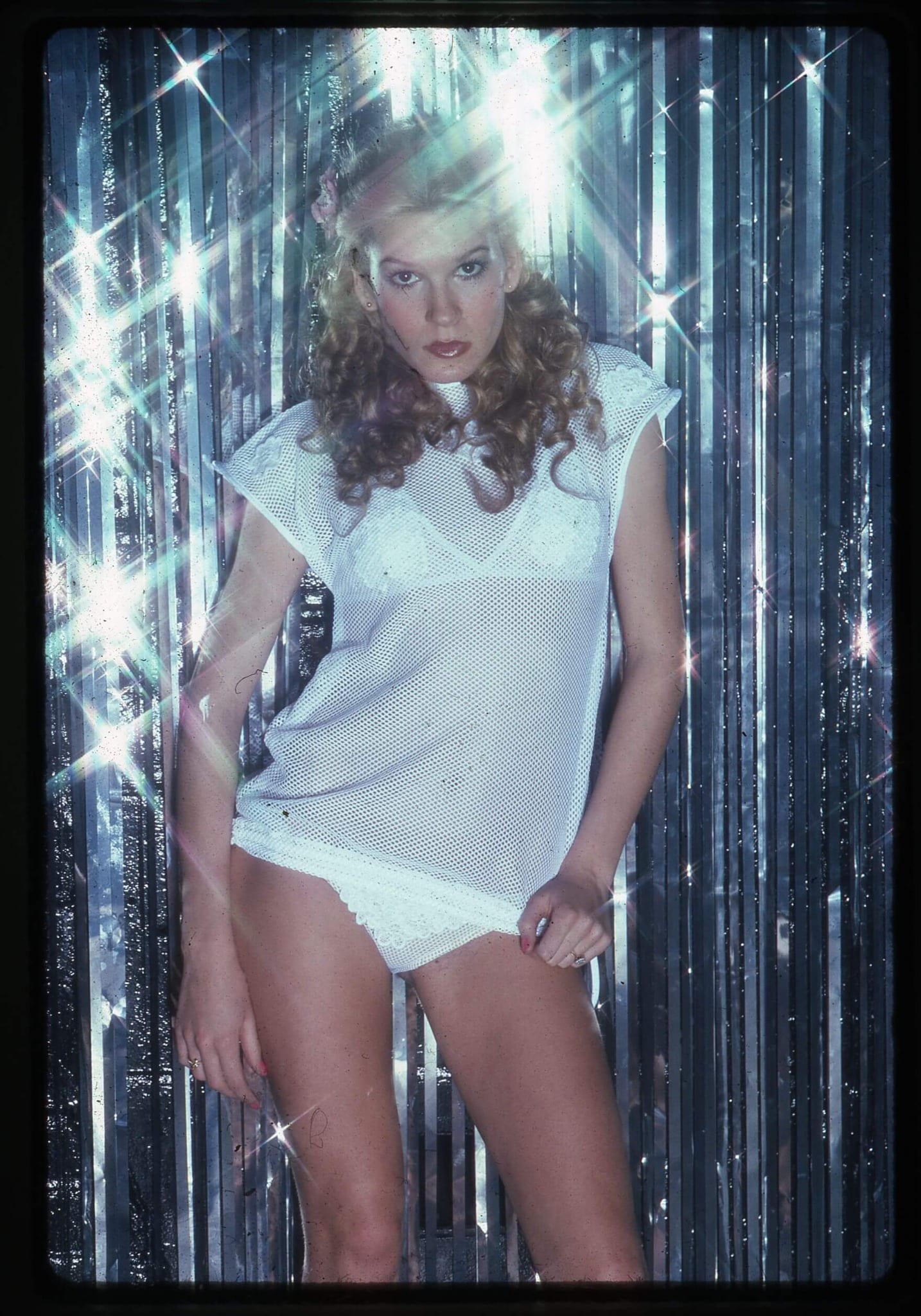
Robert Harper spent two years at the Condé Nast studios assisting a portraitist, a provocateur and a still-life perfectionist. The public record of that building explains a good deal about the 95,487 photographs that followed.
For two years Robert Harper worked at the Condé Nast studios as an assistant to three photographers: David Bailey, Helmut Newton and Lester Bookbinder. One was among the best-known British portrait and fashion photographers of his generation, one built an international reputation on charged, theatrical fashion pictures, and one was a still-life specialist whom art directors regarded as immovably exact. It is hard to think of three more different ways of running a studio.
The archive's record states the fact and stops there. It does not give the years, and it does not list the sittings. What can be added is the public history of the building, the job and the three men, which is set out below with its sources. The biographical outline is on the Robert Harper page.
What were the Condé Nast studios?
Condé Nast's British titles, Vogue among them, were based at Vogue House on Hanover Square in Mayfair, a building completed in 1958. The company announced in January 2023 that it would leave for the Adelphi building after more than six decades.
The studios inside it had a name of their own. The Chris Beetles Gallery biography of John Swannell, who worked there as an assistant in the 1960s, calls them Vogue Studios, places them on the fifth floor and describes a labyrinth of rooms in which Richard Avedon, Helmut Newton, David Bailey or Norman Parkinson might be competing for space on a given day.
Harper's record says "the Condé Nast studios" and that he had moved to London to study photography. It does not name a floor or a room, so we do not either.
What did a studio assistant actually do?
The same biography says Swannell won one of the few assistants' posts after months of rejection, that his duties included setting up backdrops and arranging lights, and that he stayed two years before David Bailey asked him, in 1969, to become his full-time assistant. That is another person's career, not Harper's, but it shows the route and the job.
In general terms, an assistant in a film-era studio was responsible for everything except the picture:
- The set. Rolling out and painting background paper, building flats, sweeping, taping.
- The light. Positioning flash heads and reflectors, metering, and recording the settings so a set-up could be repeated.
- The cameras. Loading film backs and dark slides, changing lenses, keeping track of which roll was which.
- The proof. Pulling a Polaroid test, timing it and handing it over.
- The record. Labelling exposed film for the laboratory and logging what had been shot.
The value of the job lay in watching. An assistant saw how a photographer handled a sitter, an editor, a difficult object and a late afternoon, many times over. For that reason the word used on this site is always "assisted". It claims a place in the room and nothing more.
Who were Bailey, Newton and Bookbinder?
Each had arrived in London's magazine world by the turn of the 1960s, by a different road.
| Photographer | Public career in brief | Known for |
|---|---|---|
| David Bailey (born Leytonstone, 2 January 1938) | Assistant at the John French studio in 1959; contracted to British Vogue in 1960; appointed CBE in 2001 | Direct, high-contrast portraits and fashion; the photographer in Antonioni's 1966 film Blow-Up was inspired by him |
| Helmut Newton (Berlin, 31 October 1920 to Los Angeles, 23 January 2004) | Worked for the Berlin photographer Yva from 1936; left Australia for London in February 1957 on a twelve-month British Vogue contract; settled in Paris in 1961 | Staged, provocative fashion narratives; White Women was published in 1976 |
| Lester Bookbinder (New York, 1929 to 9 January 2017) | Opened a New York studio in 1955; moved to London in 1959; contributor to Vogue, Queen and Nova; later directed commercials | Still life and advertising built from complicated compositions and studio effects |
Bookbinder is the least familiar name and, for an archive rich in still life, perhaps the most telling. A 1971 profile in Design Journal, reproduced by the advertising writer Dave Dye, quotes him: "I am by definition a commercial photographer, not an artist by any stretch of the imagination." The art director Ron Collins recalled, in the same collection of memories, nudging a glass on a Bookbinder set by about a thirty-second of an inch and being told to talk and to point, but not to touch.
These are public accounts of the three photographers. They are not accounts of Harper's time with them, and none of the three, nor any estate, has any association with Archive.London.
Three ways of making a picture
Set side by side, the three practices cover most of what a magazine asks of a photographer.
Portrait and fashion work in the manner Bailey made famous depends on speed and rapport, with the picture found in the exchange between sitter and camera. Newton's kind of fashion story is planned like a scene from a film, with location, casting and light arranged in advance. Bookbinder's still life removes the sitter altogether and leaves only objects, surfaces and reflections, adjusted in very small steps.
It would be easy to claim that Harper took a particular lesson from each. The record does not say so, and we do not. What the archive does show is range. The catalogue's 24 principal categories run from fashion, portraits and musicians to jewellery, fragrance, watches, food and drink, and the still-life categories are among the largest. The clothing inventory alone records 6,729 unique shots across 23,115 frames.
What the archive preserves from the working process
A studio training leaves its mark less in finished pictures than in the material around them, and here the archive's inventory is detailed in what it lists.
The analogue holdings are mostly medium-format colour transparencies, with black-and-white negatives, contact sheets, larger-format film and 35mm slides. There are more than 4,000 individual Polaroid prints, the subject of our article on what the test shots show. The catalogue describes a collection of magazine fashion set-ups, 88 unique shots across 389 frames, and another of published magazine and newspaper pages, 79 page groups across 364 frames, in which the inventory names Elle, Esquire, Cosmopolitan, Vogue, Wallpaper, The Face and Harpers & Queen.
The same precision later went into commercial still life, including the work described in photographing De Beers diamonds.
All counts are inventory figures and have not been checked frame by frame against the physical material; collections may overlap.
What is not yet known
The years of the two years are not recorded. Nor are the sittings, the magazines they were for, or whether any film, Polaroid or notebook from that period is in the boxes. The archive holds 52,684 unique analogue photographs and that material largely awaits scanning and cataloguing, so more than half of the archive is still on film and has yet to be scanned, and only a small selection has been published online by Archive.London.
For photographic historians, that is the point of interest. The assistants of the 1960s and 1970s became the working photographers of the 1980s and 1990s, and a studio output held in one place by one owner is the kind of evidence that history is written from. This one is being opened now, and what it shows about the passage from assistant to studio will depend on what the film turns out to hold.
Research enquiries
Curators, historians and writers working on British magazine photography can ask about the working material, the published pages and the uncatalogued film through professional access.
Frequently asked questions
What did a photographer's assistant do in the Condé Nast studios?
An assistant prepared the studio so the photographer could concentrate on the picture: building and painting backdrops, positioning lights, loading film, metering, keeping exposure notes and clearing up afterwards. John Swannell, an assistant at Vogue Studios in the 1960s, is described by his gallery as setting up backdrops and arranging lights. It was a practical training in working to a magazine deadline.
Where were the Condé Nast studios in London?
Condé Nast's British magazines were based at Vogue House on Hanover Square, completed in 1958. A published gallery biography of John Swannell places the studios, known as Vogue Studios, on the building's fifth floor. Condé Nast announced in January 2023 that it would leave Vogue House for the Adelphi building after more than six decades.
Did Robert Harper assist David Bailey?
Yes. The archive records that Harper spent two years at the Condé Nast studios assisting David Bailey, Helmut Newton and Lester Bookbinder. The record does not give the years or list particular sittings. The statement describes a studio role and implies no endorsement of the archive by Bailey or by the Newton or Bookbinder estates.
Who was Lester Bookbinder?
Lester Bookbinder (1929 to 9 January 2017) was a New York-born photographer and commercials director who worked in Britain. He opened a studio in New York in 1955, moved to London in 1959 and became a contributor to Vogue, Queen and Nova. He was best known for exacting still-life advertising photography and complicated studio effects.
What happened after Robert Harper left the Condé Nast studios?
He worked as a freelance assistant to Terence Donovan, Tony McGee, Alan Randall and Alex Chatelain, and then established his own London studio, which became a hub for young trainee photographers. He became a regular contributor to Elle and The Telegraph Magazine for more than fifteen years, and his work also appeared in Vogue, Tatler, Cosmopolitan, Esquire, The Face, Wallpaper and Harpers & Queen. Clients included De Beers, Harrods, Selfridges and Montblanc.
Sources
- John Swannell biography, Chris Beetles Gallery
- Vogue House (Wikipedia)
- Condé Nast leaves Vogue House after six decades, Genesis Publications, 19 January 2023
- David Bailey (Wikipedia)
- Helmut Newton (Wikipedia)
- Lester Bookbinder (Wikipedia)
- Lester Bookbinder: Advertising, Dave Dye, 5 November 2015
Published by Archive.London. Corrections are welcome under our editorial policy.