
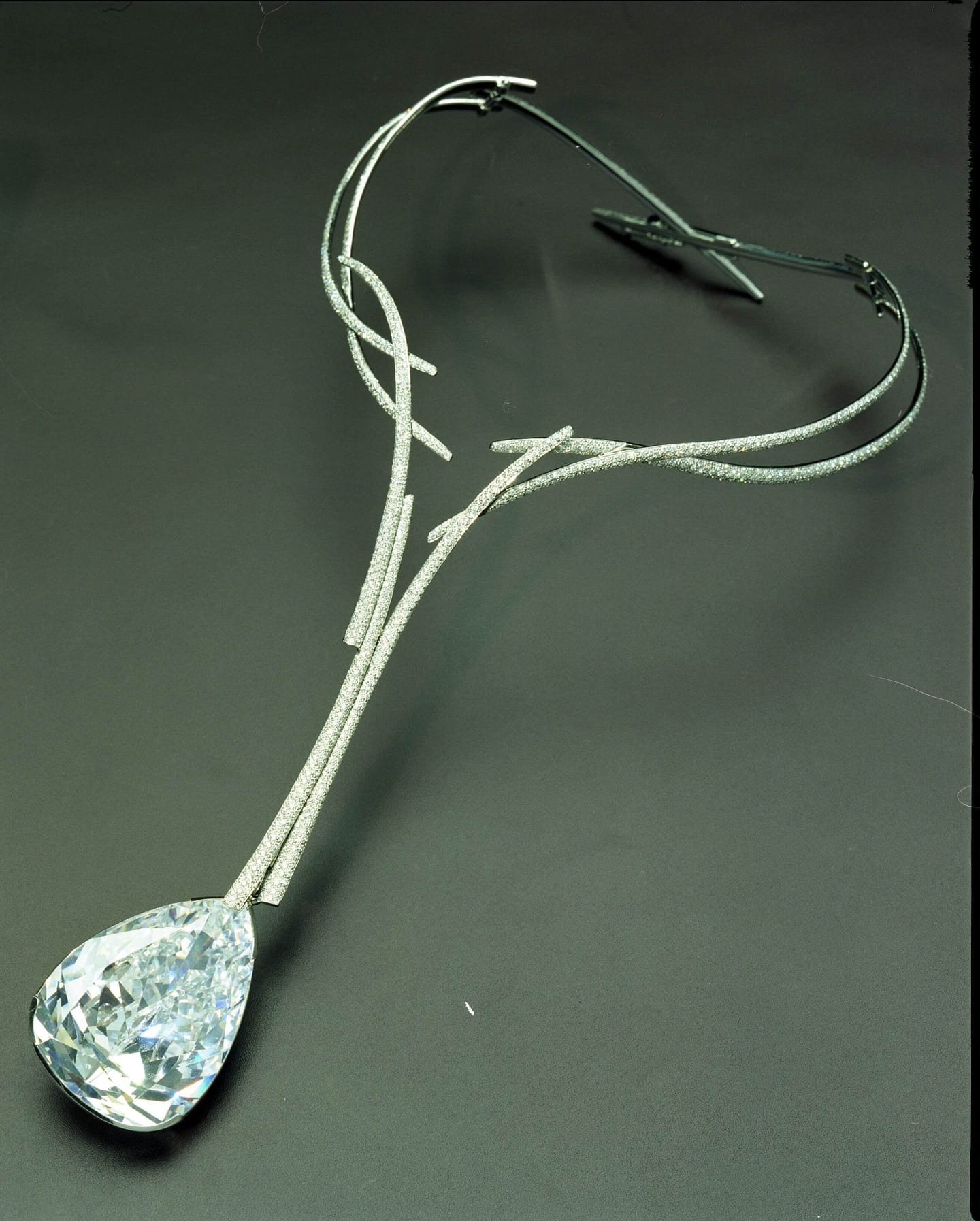
The inventory of the Robert Harper Photograph Library names De Beers, diamonds and the Millennium Star, a 203.04-carat stone. Here is what is recorded, what is public history, and what the frames have yet to confirm.
Thirty-five unique photographs, held across 175 frames and variants. That is the size of the collection the Robert Harper Photograph Library records under De Beers and diamonds, and the original inventory names one stone in particular: the Millennium Star, a pear-shaped diamond of 203.04 carats.
The ratio is the first thing a picture editor will notice. Five frames for every unique shot suggests that variants were kept alongside the selections. The De Beers diamonds collection is small, specific and, like most of the analogue archive, not yet fully described frame by frame.
What does the archive record about De Beers?
Two separate facts, which are worth keeping apart.
First, De Beers is listed among Robert Harper's commercial clients, alongside Harrods, Selfridges, Boots, Heinz, Diageo, the BBC, CBS Records and Montblanc. That is a statement about a past working relationship.
Second, the inventory has a category recorded as "Jewellery, De Beers / Diamonds", whose recorded subjects are De Beers, diamonds and the Millennium Star diamond. The catalogue counts 35 unique shots and 175 total frames and variants.
The catalogue then says something unusual for sales copy, and it deserves quoting: "Further specifications, dates and campaign connections remain to be established from the photographs and accompanying records." In other words, the inventory wording is a starting point. Which frames show which stones, when they were made and what they were made for has not yet been set down.
Neither fact implies that De Beers endorses the archive or has any connection with it today.
What is the Millennium Star diamond?
The stone's public history is well documented.
| Fact | Detail |
|---|---|
| Weight | 203.04 carats (40.608 g) |
| Cut and grade | Pear shape; D colour; internally and externally flawless |
| Rough | 777 carats, found in 1990 in alluvial deposits in the Mbuji-Mayi district of Zaire, now the Democratic Republic of the Congo |
| Cutting | More than three years, by the Steinmetz Diamond Group, using lasers |
| First displayed | October 1999, as the centrepiece of the De Beers Millennium diamond collection |
| Companion stones | Eleven blue diamonds totalling 118 carats, including the Heart of Eternity |
| Exhibited | Millennium Dome, London, during 2000 |
It was at the Dome that the stone became front-page news. On 7 November 2000, police foiled a plot to steal the collection and arrested the raiders before they could escape. The episode has since been the subject of a book and, in 2025, a Netflix documentary.
Whether the archive's frames belong to the period of the stone's unveiling, its exhibition or some other occasion is one of the questions the catalogue leaves open. We make no claim about it.
How De Beers built the diamond image
De Beers was founded in 1888 by Cecil Rhodes, and in the twentieth century its advertising became as well known as its mines. In 1947 Frances Gerety, a copywriter at the American agency N. W. Ayer & Son, wrote the line "A Diamond is Forever". Advertising Age later named it the best advertising slogan of the twentieth century.
The campaigns that followed sold ideas as much as stones: the eternity ring as a mark of continuing affection, the trilogy ring for a relationship's past, present and future, the right-hand ring as something a woman bought for herself. Each depended on photographs in which a very small, colourless object had to carry a great deal of meaning.
The company moved into retail under its own name in 2001, when De Beers Diamond Jewellers was set up as a joint venture with LVMH. Its first boutique opened in 2002 on Old Bond Street, a short walk from New Bond Street, which appears in the archive's 1976 street photographs.
This is the public background against which any photographer working for De Beers was operating. It is not a description of Harper's assignments, which the record does not detail.
Why diamonds are hard to photograph
A diamond has almost nothing a camera can hold on to. It has no colour in the ordinary sense. What the eye reads as brilliance is light entering the stone, bouncing between facets and leaving again, and what it reads as fire is that light split into colours. Photograph it badly and the result is either a grey pebble or a white flare.
The general problems are well known to still-life photographers:
- Reflection. Every facet is a small mirror. Lights, camera, ceiling and photographer all appear in the stone unless they are hidden or controlled.
- Contrast. Soft, even light removes glare but also removes sparkle. A diamond needs dark and bright areas placed deliberately around it so the facets read as distinct planes.
- Depth of field. At close range only a thin slice of the subject is sharp. The table, the girdle and the setting compete for it.
- Dust. At magnification, a speck on a facet looks like a flaw in the stone.
- Colour. On transparency film, exposure and colour had to be right in the camera. A colourless stone shows any cast immediately.
On film, with no screen to check, the usual safeguard was a Polaroid proof before the real exposure, a practice described in our piece on the archive's Polaroid test shots. The catalogue notes, in general terms, that related frames in the De Beers group "may reveal alternative lighting, positioning and editorial choices". Whether they do is for the scans to show.
Where the diamonds sit in the wider jewellery archive
The De Beers frames are a small part of a much larger body of jewellery photography. The jewellery holdings record 1,607 unique shots across 6,090 frames: rings, necklaces, pendants, bracelets, bangles, earrings, brooches, cufflinks, pearls, crosses, tiaras and group studies. Watches account for a further 611 unique shots across 1,760 frames.
Behind that sits the training described in two years in the Condé Nast studios, where one of the three photographers Harper assisted, Lester Bookbinder, was a still-life specialist. The line from that studio to a table-top of diamonds is easy to draw, though the record itself does not draw it.
All of these counts come from the archive's inventory and are not yet checked frame by frame against the physical material. Collections may overlap, so the figures should not be added together.
What remains to be established
For a jewellery historian or a heritage team, the open questions are the useful ones:
- Which of the 35 shots show the Millennium Star, and which show other stones or finished pieces.
- The dates of the photographs.
- Whether they relate to advertising, editorial, catalogue or press use.
- What film formats the 175 frames are on, and what notes, if any, are filed with them.
None of this is answered in the published catalogue. The analogue archive records 52,684 unique photographs, and that material largely awaits scanning and cataloguing. More than half of the archive is still on film and has yet to be scanned, and only a small selection has been published online by Archive.London, and the De Beers category is a clear example of what frame-level work could add: a named client, a named stone and a set of sequences in which only the outline is so far known.
For the jewellery trade and brand archivists
Jewellery houses, auction specialists, publishers and brand heritage teams who want to know what the frames show can read how enquiries are handled on the page for picture agencies and researchers, or write to the archive through the contact page. Licensing is by negotiation with the single rights holder, subject to rights review.
Frequently asked questions
Did Robert Harper photograph for De Beers?
De Beers is listed among Robert Harper's commercial clients, and the archive's inventory has a category recorded as De Beers and diamonds, including the Millennium Star diamond. It contains 35 unique shots across 175 frames. The catalogue is explicit that dates, specifications and campaign connections remain to be established from the photographs and accompanying records.
What is the Millennium Star diamond?
The Millennium Star is a pear-shaped diamond of 203.04 carats, graded D colour and internally and externally flawless. It was cut from a 777-carat rough found in 1990 in the Mbuji-Mayi district of what was then Zaire. The Steinmetz Diamond Group took more than three years to cut it, and it was first displayed in October 1999.
Why are diamonds difficult to photograph?
A diamond has no surface colour of its own. It is seen through reflection and refraction, so it mirrors everything around it, including lights, camera and photographer. Too much diffuse light makes it look flat and grey; too little control produces glare. Scale adds shallow depth of field and visible dust. Good diamond photography balances brilliance against a clear reading of the cut.
Are the De Beers photographs in the archive available to license?
Licensing is available by negotiation with 825 Ventures Ltd, the owner and rights holder, and is subject to rights review. The photographs show a named company's diamonds, so any proposed use needs individual assessment. Nothing in the catalogue implies that De Beers endorses, or has any present connection with, the archive.
Sources
Published by Archive.London. Corrections are welcome under our editorial policy.