
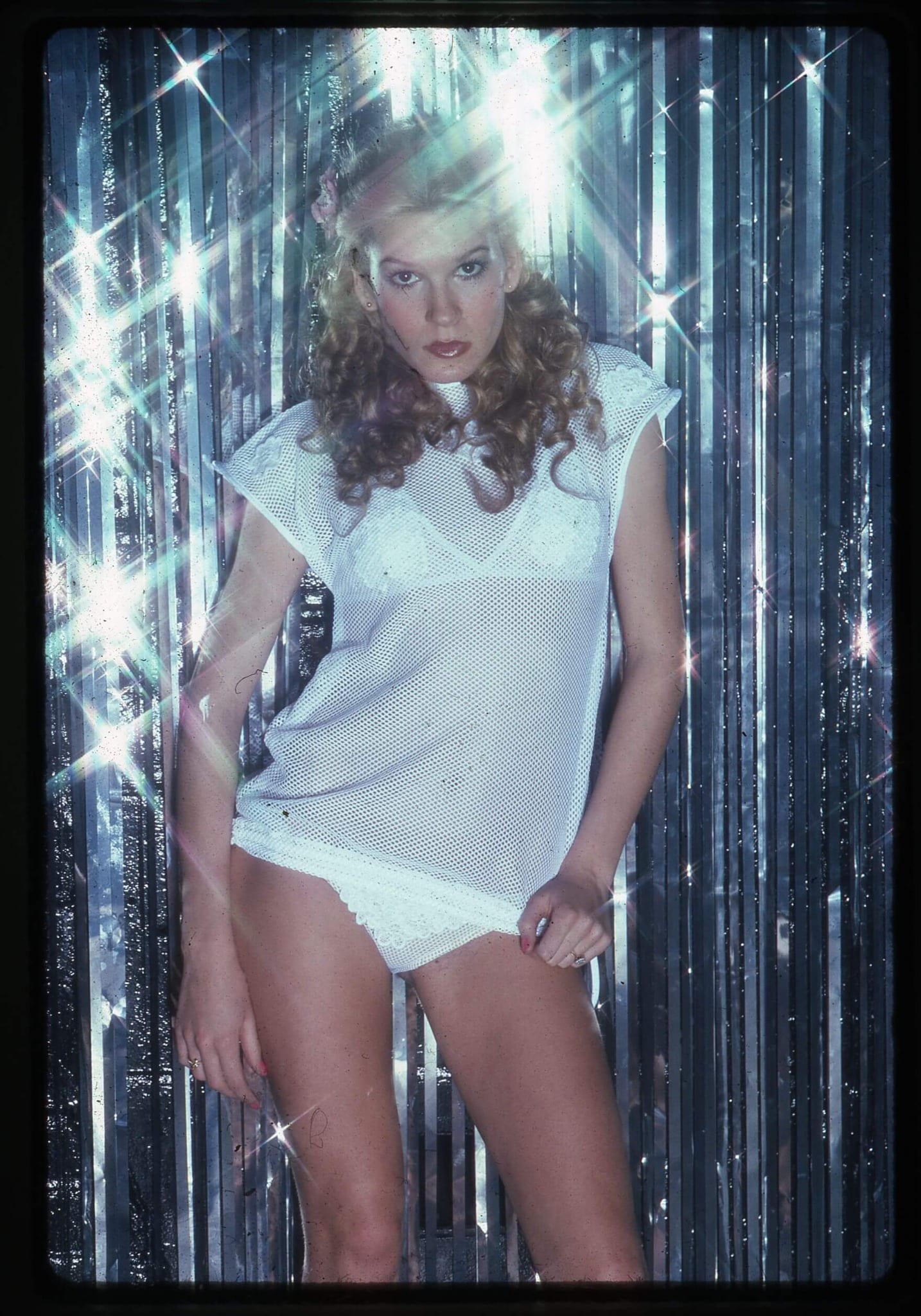
One photographer took things out of the frame until only a face was left. The other kept adding: a hotel, a chauffeur, a plot. A comparison made from documents, not legend.
Bailey subtracts until only the sitter is left to blame; Newton adds until the sitter is one clue among many.
David Bailey and Helmut Newton are usually compared by reputation: the East End charmer and the Berlin provocateur. Reputation is the least useful evidence available. The better comparison is mechanical. Look at what each man put behind the sitter. In Bailey's defining portraits there is nothing behind the sitter at all, and in Newton's defining fashion pictures there is a whole apparatus of rooms, cars and implied events. One method works by subtraction and the other by addition, and almost every other difference between them (light, casting, cropping, even how their books are organised) follows from that single choice. This piece makes the comparison from dated, published sources, and says where the sources disagree.
We have a reason to care. Robert Harper, whose library Archive.London looks after, spent two years at the Condé Nast studios in London assisting both men, along with the still-life photographer Lester Bookbinder. That is all the record says, and we will not embroider it. But it does mean the two approaches described here were, for one assistant, two rooms in the same building.
Who were David Bailey and Helmut Newton, in dates?
The biographies barely overlap, which matters more than it first appears.
Newton was born Helmut Neustädter in Berlin on 31 October 1920. The Helmut Newton Foundation records that he was apprenticed from 1936 to 1938 to Yva (Else Simon, née Neuländer), a portrait, nude and fashion photographer in Charlottenburg, and that he left Berlin by train in 1938 carrying two still cameras. He worked briefly in Singapore, reached Australia in 1940, served in the Australian army, and opened a studio in Melbourne after the war. He settled in Paris in 1961 with a full-time position at French Vogue. He was, in other words, a pre-war European studio apprentice who arrived at his mature style in his fifties.
Bailey was born on 2 January 1938 in Leytonstone and grew up in East Ham. He left school at fifteen, did national service with the RAF in Singapore in 1957, bought a Rolleiflex and then a Canon rangefinder, and in 1959 became an assistant at the studio of John French. Later in 1960 he was contracted to British Vogue. He was twenty-two. The first Sunday Times Colour Section, on 4 February 1962, carried his photograph of Jean Shrimpton in a Mary Quant dress on its cover.
So one man was formed by Weimar Berlin and exile and came to fame late; the other was formed by post-war London and came to fame almost at once. Eighteen years separate their births, and the gap shows in the pictures.
One small caution about dates, because it illustrates how even well-documented lives wobble. The Foundation's chronology puts Newton's one-year contract with British Vogue in 1956 and says he left after 11 months. The Wikipedia biography, citing other sources, has him leaving for London in February 1957 on a 12-month contract that he left early. Both agree that he left before the year was out. Neither is obviously wrong; a contract signed late in one year and worked in the next would produce exactly this disagreement.
What does a David Bailey portrait look like?
The reference object is Box of Pin-Ups, the portfolio of poster prints that Bailey published in the mid-1960s (most catalogues say 1965; some references give 1964). Its sitters included the Beatles, Mick Jagger, Jean Shrimpton, Cecil Beaton, Rudolf Nureyev and the Kray twins, and the inclusion of the Krays so offended Lord Snowdon that, according to the standard account, no American edition was issued.
The pictures share a grammar. The background is plain and pale. The sitter is close, often cropped at the top of the head or the shoulder. There are no props to speak of and no location. The print is black and white and contrasty. Nothing in the frame tells you who this person is, what they do or where they are, so the face has to do all of it. That is a severe thing to ask of a sitter, and it explains why the portraits that work feel like encounters, and why the ones that do not feel like passport photographs taken by a genius.
It is worth remembering where Bailey trained. John French, whose studio he joined in 1959, built his reputation on fashion pictures designed to survive newspaper reproduction: reflected light, low contrast, immaculate poise. Bailey kept the white studio and threw out the poise. The backdrop stayed; the manners left.
What does a Helmut Newton photograph look like?
Newton's first book, White Women, appeared in 1976, when he was fifty-five. Sleepless Nights followed in 1978 and Big Nudes in 1981. The Foundation describes a photographer who "always managed to surprise and polarize his audience" and who "straddled the gap between art and commerce". The New York Times, quoted in his Wikipedia biography, called him a "prolific, widely imitated fashion photographer" known for "provocative, erotically charged black-and-white photos".
The grammar is the opposite of Bailey's. A Newton fashion picture generally has a place (a hotel room, a street at night, a poolside), a relationship between figures, and a suggestion that something has just happened or is about to. The clothes are present because the story needs costumes. The woman in the frame is rarely a passive subject; the charge of the pictures, and the long argument about them, comes from the way they stage power. Wikipedia's fashion photography survey summarises the work as erotic and stylised, often with sadomasochistic and fetishistic undertones, and that description has been attached to him by admirers and critics alike.
The useful exception is Big Nudes. In 1980 Newton began photographing full-length nudes against a stark studio backdrop, with no hotel and no plot. It is as close as he came to Bailey's bare room. Yet nobody would mistake one for the other: Bailey's blank background isolates a personality, while Newton's isolates a body and a stance. The same white paper produces two different subjects.
Bailey vs Newton: how do the two approaches compare?
| David Bailey | Helmut Newton | |
|---|---|---|
| Born | 2 January 1938, Leytonstone, London | 31 October 1920, Berlin |
| Training | Assistant at the John French studio, 1959 | Apprentice to Yva, Berlin, 1936 to 1938 |
| Principal magazine base | British Vogue, contracted 1960 | French Vogue, full time from 1961 |
| Reference publications | Box of Pin-Ups (mid-1960s); Goodbye Baby & Amen (1969) | White Women (1976); Sleepless Nights (1978); Big Nudes (1981) |
| Typical setting | Plain studio background | Hotels, streets, interiors; studio for Big Nudes |
| What carries the picture | The sitter's face and attention | The scenario, and the figure's stance within it |
| Usual reading | Portraiture | Staged narrative, erotic charge |
| Institutional home | Major retrospective, Bailey's Stardust, National Portrait Gallery, 2014 | Helmut Newton Foundation, Berlin, agreed 2003 and opened 2004 |
A table makes them look tidier than they were. Bailey shot on location and made films and commercials; Newton made portraits. The point is where the weight of each reputation rests.
Why does the background matter so much?
Because the background decides who is responsible for the picture. On plain paper, with the camera close, the sitter cannot hide in a role, and the photographer cannot hide behind production. Whatever happens in the exposure happens between two people. Bailey subtracts until only the sitter is left to blame.
In a staged scene, responsibility moves to the author. The model plays a part that the photographer has written; the location, the styling and the light are all doing narrative work. Newton adds until the sitter is one clue among many. This is why Newton's pictures invite interpretation in a way Bailey's seldom do, and why the arguments about Newton are arguments about what the pictures mean, while the arguments about Bailey tend to be about who was in the room.
For anyone learning to light or to direct, the practical lesson is that neither approach is the easy one. The empty studio leaves nowhere to put a mediocre idea. The staged scene multiplies the number of things that can look false.
How should a researcher or collector use this comparison?
Carefully, and with dates. Three working rules follow from the record.
First, do not attribute by style. A plain white background and a hard crop do not make a picture a Bailey, and a hotel corridor does not make one a Newton; both approaches were widely imitated within a few years. Our guide to tracing the photographer of an old magazine picture sets out the methods that do work.
Second, read the magazine before the monograph. Both men's best-known pictures were commissions, printed first in Vogue and its rivals, and the original spread tells you things a later book crops out: the season, the editor, the clothes credit.
Third, treat assistants' accounts as evidence about studios, not about authorship. Robert Harper's two years at the Condé Nast studios, described in our piece on assisting Bailey, Newton and Bookbinder, tell us about his training. They do not make any picture in his archive a Bailey or a Newton, and nothing here should be read that way.
Our index of photographers gives short, sourced entries for both men and for others in their circle, and the photography directory lists the museums and foundations where the work can be seen.
What does the Robert Harper archive hold that bears on this?
Not Bailey's pictures or Newton's. What it holds is the work of someone trained in the same studios who then spent roughly thirty-five years photographing fashion, portraits, jewellery and still life on his own account, as his biography sets out. The inventory lists 72 clothing folders, 88 catalogued magazine fashion set-ups across 389 frames, and 479 frames of models and catwalk, most of it on 6 x 7 colour transparency film and much of it still unscanned. Whether any of it shows the subtracting habit or the adding one is a question that can only be answered by looking, and the fashion collection is where that looking starts. If you want to compare two scans side by side while you do, our free image compare tool runs in the browser.
Curators, researchers and publishers who would like to see material from the library can ask for professional access.
Frequently asked questions
What is the difference between David Bailey's and Helmut Newton's style?
Bailey's best-known portraits remove setting: a sitter, close, against plain paper, in black and white, so that expression carries the picture. Newton's best-known fashion pictures add setting: hotels, streets, cars and implied stories, usually with a charge of power or desire. Bailey's work is mostly read as portraiture that happens to include fashion; Newton's as fashion that behaves like cinema.
Did David Bailey and Helmut Newton work for the same magazines?
Both worked for British Vogue, at different times and on different terms. Bailey was contracted to British Vogue in 1960 and stayed associated with it for decades. Newton held a one-year British Vogue contract in the mid-1950s, left early, and from 1961 was based in Paris, working full time for French Vogue with occasional work for British Vogue and Queen.
What is David Bailey's Box of Pin-Ups?
It is a boxed portfolio of poster prints of 1960s figures photographed by Bailey, among them the Beatles, Mick Jagger, Jean Shrimpton, Cecil Beaton, Rudolf Nureyev and the Kray twins. Most catalogues date it to 1965, though some references give 1964. Lord Snowdon's objection to the inclusion of the Krays is cited as a major reason no American edition appeared.
What are Helmut Newton's Big Nudes?
Big Nudes is a series of full-length nudes that Newton began in 1980, photographed against a stark studio backdrop and printed at large scale. The Helmut Newton Foundation lists the book Big Nudes as published in Paris by Éditions du Regard in 1981. It is the point at which Newton's work comes closest to Bailey's bare studio, and the comparison is instructive.
Did Robert Harper work with David Bailey and Helmut Newton?
The archive records that Robert Harper spent two years at the Condé Nast studios in London assisting David Bailey, Helmut Newton and Lester Bookbinder. It does not give the years or name particular sittings. The statement describes an assistant's role and implies no endorsement of the archive by Bailey or by the Helmut Newton Foundation.
Sources
- Helmut Newton biography and publications, Helmut Newton Foundation
- Helmut Newton (Wikipedia)
- David Bailey (Wikipedia)
- John French (photographer) (Wikipedia)
- The Sunday Times Magazine (Wikipedia)
Published by Archive.London. Corrections are welcome under our editorial policy.