
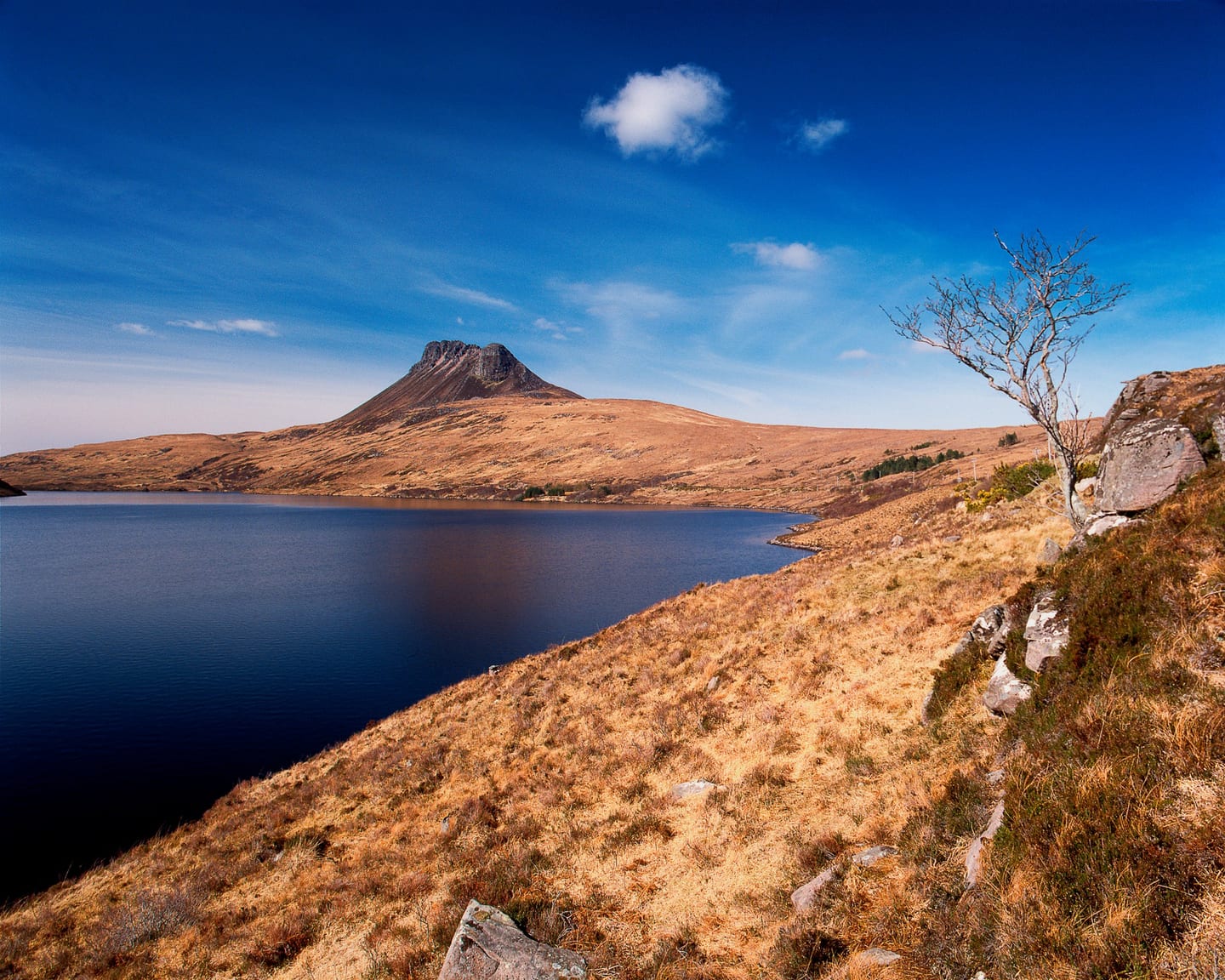
In 1975 Robert Harper photographed landscapes, rustic buildings and off-grid living in black and white. The 560 frames survive as negatives and contact sheets. Where they were taken is not yet on record.
The Robert Harper Photograph Library records 560 black-and-white photographs under a single year, 1975. Their subjects, in the inventory's words, are landscapes, rustic buildings and off-grid living. They survive as negatives and contact sheets, and the count of unique shots equals the count of frames, 560 of each.
One thing the inventory does not record is where. The collection is filed among the landscapes, and its photographer was born in Scotland and grew up in Glasgow and on Islay. But the black-and-white landscapes and off-grid life collection carries no place name, and this article will not give it one. What follows sets out what is recorded, what the archive holds of Scotland for certain, and why a set of 1975 contact sheets is worth a researcher's attention.
What does the archive record about the 1975 photographs?
The catalogue's provenance note is brief:
- Original category: Landscapes & Skyscapes 2, Black & White
- Unique shots: 560
- Total frames: 560
- Date recorded: 1975
- Formats recorded: black-and-white negatives and contact sheets
- Subjects: landscapes, rustic buildings and off-grid living
That is all. No region, no named buildings, no named people. The record does not say whether the photographs were made on one journey or several, or whether they were an assignment or personal work. It gives the film format only as "negatives", without a size.
A dated group of this size, in one medium, on one theme, is nonetheless coherent. Most of the archive is colour and most of it is studio work. This is neither.
Were they taken in Scotland?
It is a reasonable guess and it remains a guess.
The case for it is circumstantial. Robert Harper was born in Scotland and grew up in Glasgow and on the island of Islay. The archive's other landscape material is recorded as including Scotland and the Highlands. The archive's own Scotland page discusses the 1975 group alongside the Scottish slides.
The case for caution is that the inventory line itself names no country, and the same colour landscape category that records the Highlands also records New York and London. Until frames are scanned and compared with known places, the location is unconfirmed. Readers looking for Scottish landscape photography of the 1970s should treat this set as a candidate, not a certainty.
What the archive holds of Scotland for certain
Here the record is firmer.
| Collection | Count | Format and subjects recorded |
|---|---|---|
| Scotland landscapes, seascapes and churches | 481 unique shots | 35mm colour slides; landscapes, seascapes, sunsets, churches |
| Colour landscapes and skyscapes | 1,135 unique shots | Scotland, the Highlands, New York and London, in varied weather, seasons and times of day |
| Black-and-white landscapes, 1975 | 560 unique shots | Negatives and contact sheets; place not recorded |
The Scotland holdings page is careful on one point that matters: the categories overlap, so the numbers must not be added together without image-level cataloguing. The colour and black-and-white landscape groups make up the dedicated landscape holding of 1,695 photographs. How much of the colour group is Scottish is not broken down, and exact locations in every group await frame-level work.
The places themselves need little introduction. Islay is the southernmost island of the Inner Hebrides, about 620 square kilometres of moorland, farmland and shore, with a little over 3,000 inhabitants, its capital at Bowmore and its main port at Port Ellen. The Highlands are the mountain and loch country to the north and west of the central belt. Whether any given slide shows either is, again, something only the slides can settle.
1975: the year self-sufficiency went mainstream
The inventory's phrase "off-grid living" is a modern one. In 1975 the words in use were self-sufficiency, smallholding and going back to the land, and that year they reached a mass audience.
John Seymour, who had described his own smallholding in The Fat of the Land in 1961, published Self-Sufficiency with Sally Seymour in 1973 and The Complete Book of Self-Sufficiency in 1976. Between the two, on 4 April 1975, BBC1 broadcast the first episode of The Good Life, in which a suburban couple in Surbiton try to live off their own garden. It ran until 1978.
There was also an older reality that had never needed the fashion. In parts of rural Britain, particularly remote and island districts, houses without mains services were an inheritance, not a choice.
Which of these the 1975 photographs show is not recorded. "Rustic buildings and off-grid living" could describe either, or both. A historian would want to know, and the answer is on the negatives.
What do contact sheets add to a landscape archive?
A contact sheet is made by laying strips of negatives directly onto photographic paper and exposing them, giving a same-size positive of every frame in shooting order. For a set like this one it adds three kinds of evidence that single prints cannot.
Sequence. Frame numbers run in the order the shutter was pressed. A sheet shows the approach to a building, the walk around it and the move on to the next subject.
Selection. Photographers marked contact sheets, typically in chinagraph pencil, to show which frames to print. Whether Harper's sheets carry such marks is not recorded in the catalogue.
Completeness. The frames that were never printed are still there. For documentary subjects they are often the most informative, because they include the incidental details an editor would have cut.
Negatives also scan well. Anyone working with their own can invert a photographed negative with the film negative to positive converter, and assemble scanned frames into a sheet with the contact sheet maker. The archive's broader stock of working material, including the instant prints discussed in what the Polaroid test shots show, tells a similar story about process.
Why black and white, when the career was in colour?
The archive's analogue holdings are described as mostly medium-format colour transparencies, the working material of magazine and advertising photography. Black-and-white negatives are listed as a smaller part.
The record gives no reason for the choice in 1975, and we will not supply one. The general point is that black-and-white negative film was the documentary photographer's standard material in the mid-1970s: cheaper than colour, tolerant in exposure, and printable in an ordinary darkroom. Without colour to separate grass from stone or water from sky, a picture has to be organised by tone and texture.
The same decade appears in the archive in a very different setting, described in New Bond Street, 1976. The Scottish slides and the London streets mark the two ends of a biography, the country Harper came from and the city he went to work in, a story told in from Islay to the Condé Nast studios.
What has not been catalogued, and who can help
For the 1975 set, almost everything beyond the outline:
- The country, region and places shown.
- The identity of any buildings or people.
- The film size, and how many contact sheets there are.
- Whether the sheets are marked up or annotated.
- Whether any frame was published.
The wider position is the same. The archive records 52,684 unique analogue photographs, and that material largely awaits scanning and keyword cataloguing. More than half of the archive is still on film and has yet to be scanned, and only a small selection has been published online by Archive.London. All counts here are inventory figures and have not been checked frame by frame against the physical material.
A dated, single-theme group of 560 negatives is about as well defined a first project as an archive can offer: small enough to scan in one campaign, and specific enough that the result would answer a real question.
Researchers of rural Britain, curators and regional publishers can ask about the 1975 set and the Scottish slides through professional access, and organisations able to scan and catalogue black-and-white negatives will find the brief on the digitisation partners page.
Frequently asked questions
Were Robert Harper's 1975 black-and-white landscapes taken in Scotland?
The archive's inventory does not say. It records the date, 1975, the formats, black-and-white negatives and contact sheets, and the subjects: landscapes, rustic buildings and off-grid living. Harper grew up in Glasgow and on Islay, and Scotland is recorded in other landscape collections, but the location of the 1975 set awaits confirmation from the frames themselves.
How many Scottish photographs are in the Robert Harper archive?
A dedicated Scotland section records 481 colour photographs on 35mm slides, covering landscapes, seascapes, sunsets and churches. Scotland and the Highlands also appear within a colour landscape collection of 1,135 images that includes New York and London. The categories overlap, so the figures cannot be combined into a single Scottish total without image-level cataloguing.
What is a contact sheet and why does it matter for landscape photography?
A contact sheet is a same-size print of every frame on a roll or set of negatives, made by laying the strips directly on photographic paper. It shows the frames in the order they were shot. For landscape work it reveals the route the photographer took, how long was spent on each view and which frames were chosen.
What does off-grid living mean in a 1975 photograph?
Off-grid is the catalogue's label, and a modern phrase, for homes without mains services such as electricity. In the mid-1970s the usual words were self-sufficiency and smallholding. The inventory does not identify the people or buildings in the 1975 photographs, or say whether they show long-established rural life or newer arrivals.
Can the 1975 landscapes be licensed or exhibited?
Licensing is available by negotiation with 825 Ventures Ltd, the owner and rights holder, subject to rights review; exhibition proposals can be raised in the same way. The 1975 material is recorded on negatives and contact sheets, so most uses would first require scanning. Archive.London is actively seeking digitisation and exhibition partners for work of this kind.
Sources
Published by Archive.London. Corrections are welcome under our editorial policy.