
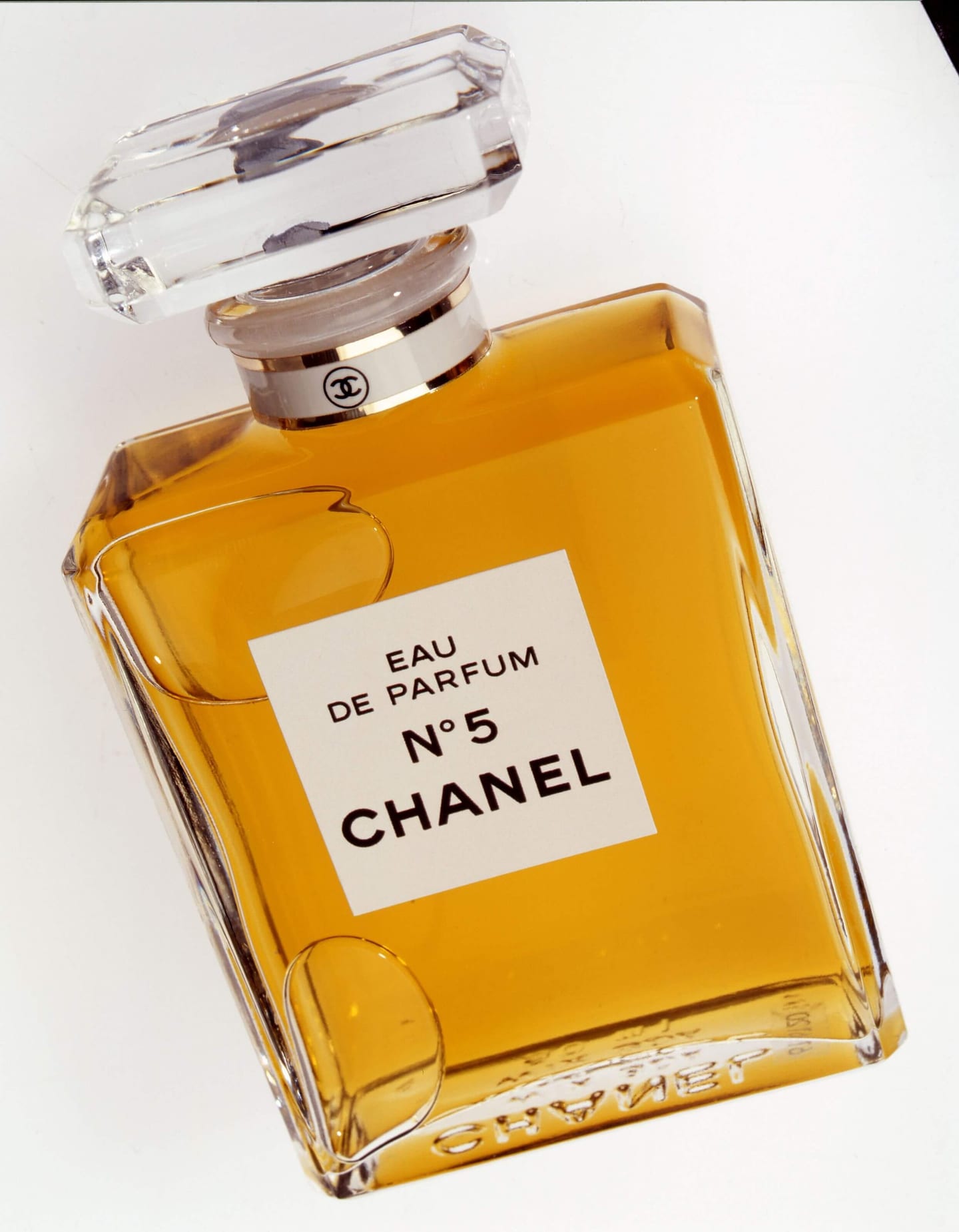
A perfume bottle is a transparent object filled with coloured liquid, capped in metal and printed with fine type. Each part wants different light, and all of it reflects the studio.
Clear glass is close to invisible. In a photograph, a bottle exists only as its edges, its reflections and whatever can be seen through it. Fragrance bottle photography is the craft of controlling those three things at once, around an object that also contains coloured liquid, wears a metal cap and carries a name in small type that must be legible.
The Robert Harper Photograph Library's inventory records 1,028 unique fragrance shots across 3,000 frames. This article sets out the general studio principles behind pictures of that kind, particularly as they applied on film. It does not attribute any particular technique, equipment or film to Robert Harper, which the inventory does not record.
Why is glass so difficult to photograph?
Because it does three things with light and a photographer has to manage all of them.
- It transmits. You see the background through it, bent and compressed by the curve of the glass.
- It refracts. At the edges, where the glass is seen obliquely, light is bent so far that the edge shows a different part of the surroundings from the middle. This is what draws the outline.
- It reflects. The front surface acts as a weak mirror of everything on the camera side of the set.
Direct light from the front does very little for the first two and a great deal of harm with the third: it produces hard reflections on the surface and leaves the glass itself shapeless. That is why glass is lit, for the most part, from behind.
What are bright-field and dark-field lighting?
They are the two classic answers to the question of how to draw an edge.
| Bright-field | Dark-field | |
|---|---|---|
| Background behind the bottle | Light, evenly lit | Dark |
| Where the light comes from | The background itself, just filling the frame | Around and behind the dark background, out of frame |
| How the edges appear | Dark lines | Bright lines |
| Overall mood | Clean, airy, fresh | Rich, dramatic, evening |
| Main risk | Edges too thin and weak | Stray reflections on the front surface |
In a bright-field set-up, the bottle stands in front of a lit white surface that is only a little larger than the frame. The edges of the glass refract the darkness beyond that surface, so they show as dark lines. Black cards placed just out of shot at either side strengthen them.
In a dark-field set-up, a dark card sits directly behind the bottle, and a larger light source behind the card shows around its edges. The centre of the glass sees darkness; the rim of the glass refracts the light. The bottle appears as a drawing in light on black.
Either can be modified by degrees, and many fragrance photographs sit between the two, with a graduated background that moves from light to dark behind the bottle.
How is the liquid made to glow?
Perfume is usually a pale amber, pink or green, and in a bottle it can photograph as a murky brown. Colour in a transparent liquid is only seen when light passes through it to the camera.
A bright background does this automatically, which is one reason bright-field lighting flatters scent. Against a dark background, the standard device is a small reflector hidden behind the bottle: a piece of white, silver or gold card cut to the bottle's shape but slightly smaller, angled to catch a light and send it forward through the liquid. From the camera position the card cannot be seen. The liquid simply lights up.
The level of the liquid, the meniscus and any air bubbles all become visible at this point, and are attended to. So are fill lines and seams in the glass, which the photographer turns away from the lens if the design allows.
How are the label and cap lit without glare?
Here the problem turns round. Type on a label and the metal of a cap need light from the front, and front light reflects in glass.
The solution is geometric. A reflection is seen only when the light, the surface and the camera are at matching angles. Move the light far enough to the side or above and its reflection in a flat face falls outside the lens's view, while the label still receives light. On curved bottles, where some part of the surface always faces the lamp, photographers use a large, even source so that the reflection becomes a long, clean band that describes the curve instead of a hot spot, or they narrow the light with flags so it reaches only the label.
Caps are small pieces of polished metal or lacquer and follow the rules for jewellery: they show what surrounds them, so they are given white cards to reflect for tone and dark ones for definition. Our article on jewellery photography on film covers the principle.
The surface under the bottle matters as much. A sheet of glass or glossy acrylic gives a reflection of the bottle beneath it. A sheet lit from below removes the shadow altogether.
What was different about doing this on film?
The principles are the same today. The practice was slower and less forgiving.
Everything was judged before exposure. With a large-format view camera, the image on the ground glass is upside down and dim. Reflections were hunted by looking from the lens position and by making instant-film tests, moving one card at a time. See Polaroids in the studio.
Transparency film held a narrow range. A backlit background, a dark cap and a bright reflection can exceed what colour reversal film records. Lighting ratios were measured and adjusted until the whole subject fitted.
Combining exposures was a craft. A common method was to expose the same sheet of film more than once: one exposure with only the backlight on for the glass and liquid, another with only the front light on for the label, each with its own duration or flash power. Nothing could move between the two.
Clean meant clean. Dust on glass shows as bright specks under backlight. Fingerprints show as smears. Bottles were washed, polished and handled with gloves, because removing a blemish afterwards meant skilled retouching.
Perspective was corrected in the camera. Tall bottles photographed from slightly above appear to taper. Keeping the film plane vertical and using the view camera's rise and shift movements kept the sides parallel.
The result of this method is a characteristic body of film: several near-identical frames of each composition, differing in exposure or in a small adjustment. In the Harper fragrance inventory, 1,028 unique shots correspond to 3,000 frames. The inventory does not yet break those variants down by type, and the counts have not been checked frame by frame against the physical material.
What does the fragrance collection at Archive.London record?
The fragrance collection is one of the larger still-life groups in the catalogue. It is arranged partly by house, with collection pages that include Chanel fragrances (29 unique shots across 45 frames), Calvin Klein, Guerlain, Jean Paul Gaultier, Yves Saint Laurent and others, as well as group studies in which several bottles are composed together.
Three points of care apply. First, these houses appear as product subjects. Robert Harper was a regular contributor to Elle and The Telegraph Magazine for more than fifteen years, and magazine beauty and shopping pages routinely photograph products independently of the brands. The catalogue confirms the products shown; it does not establish that any photograph was commissioned by the house concerned, and no brand named has endorsed the archive. Second, bottle designs, names and logos belong to their owners, and a licence for a photograph does not include rights in them, as the image licensing terms make clear. Third, most of the material is analogue and largely awaits digitisation, so dates and publication histories for individual frames are still to be researched.
What can be said is that the collection records a long series of bottle designs as they were presented when current, photographed by one hand. For design historians, packaging researchers and brand heritage teams, that consistency is the point. Our guide to heritage brand imagery explains how companies use material of this kind and what to check first.
A working sequence for a bottle
- Clean the bottle and the surface it stands on.
- Set the camera level, with the bottle's sides parallel in the frame.
- Light the background first. Decide between dark edges on light and light edges on dark.
- Add black or white cards at the sides until the outline is firm.
- Make the liquid glow, with the background or a hidden reflector.
- Light the label and cap from an angle that keeps reflections out of the lens.
- Look for the camera and anything else reflected in the glass. Remove it.
- Check the highlights and shadows. On a digital file, the free image histogram tool shows whether either is clipped.
The fragrance photographs still on film
More than half of the Robert Harper Photograph Library is still on film and has yet to be scanned, and only a small selection has been published online by Archive.London, and that is likely to include much of its fragrance still life. Publishers, design researchers and brand heritage teams who want to know what is recorded for a particular house or period can contact the archive; licences are negotiated directly with the single rights holder, subject to rights review.
Frequently asked questions
How do you light a glass perfume bottle?
Start from behind. Light a diffusing surface behind the bottle so that the glass is defined by its edges and the liquid glows. Then add controlled front light for the label and cap, placed where its reflection in the glass is not visible to the camera. Black or white cards beside the bottle sharpen or soften the outline.
What is the difference between bright-field and dark-field lighting?
In bright-field lighting the bottle stands in front of a light background, and its edges appear as dark lines. In dark-field lighting the background directly behind the bottle is dark and light comes from around it, so the edges appear as bright lines on black. Bright-field reads as clean and fresh; dark-field as dramatic.
How do photographers make perfume look like it glows?
By sending light through the liquid towards the lens. A lit background does this generally. For a stronger effect, a piece of white or metallic card, cut slightly smaller than the bottle and hidden directly behind it, bounces light forward through the liquid. The colour then appears luminous instead of dense and dark.
Why do reflections ruin bottle photographs?
Glass reflects everything in front of it, including lights, stands, the camera and the photographer. Small bright reflections on a curved bottle look like flaws and can obscure the label. The fix is to control what the glass can see: large clean light sources, black cloth around the camera, and careful angles.
Does Archive.London hold official Chanel perfume photographs?
No official status is claimed. The archive's inventory records 29 unique Chanel fragrance shots across 45 frames as still-life product subjects photographed by Robert Harper. The catalogue confirms the products shown; it does not state that Chanel commissioned the photographs or endorses the archive, and no brand page is an official brand archive.
Published by Archive.London. Corrections are welcome under our editorial policy.