
The hard part of dressing a 1975 room is not finding things from 1975. It is knowing what was already old, what was still rented from the Post Office, and what the price label said.
A room is never all one year; it is a collection of small arguments about what its owner could afford to replace, and when.
A British living room in 1975 did not contain a telephone that its occupants owned. The instrument was rented from the Post Office and, in most homes, wired permanently into the wall, and it stayed that way until British Telecom introduced the present plug and socket on 19 November 1981 so that subscribers could connect telephones of their own. A set that shows a 1970s character bringing a telephone home from a shop and plugging it in has made a mistake no viewer under fifty will notice and every viewer over sixty will feel. Period reference is the craft of catching that kind of error before the camera does.
Most guides to period research point designers at the famous pictures of a decade. Our argument runs the other way. The famous pictures are of exceptional things; an art department needs the unexceptional ones, in colour, at close range, with the label readable. That is precisely what commercial studios were paid to photograph, for catalogues and magazine shopping pages, with no thought for history. Their archives hold the texture of ordinary life by accident, and this article explains how to use them alongside other sources.
What does an art department need from reference photographs?
Four things, in ascending order of difficulty.
The object. What did a telephone, a radio, a cereal packet, a credit card look like, from the front and the back?
The colour. Period colour is the first casualty of memory. Black-and-white documentary pictures cannot help, and faded prints mislead. A colour transparency that has been stored well and scanned with care is the best evidence of how a plastic or a printed carton looked when new. (For the caveats, see our article on why colour slides fade.)
The date. When was this object first available, and when did it change?
The mix. What stood next to what? A room is never all one year; it is a collection of small arguments about what its owner could afford to replace, and when. The commonest fault in period design is a set in which everything is brand new for the year on the script.
No single source supplies all four. Product photography is strong on object and colour. Catalogues and advertisements are strong on date. Street and documentary photography is the only source for the mix.
How do you date an object: the "not before" rule
Every manufactured thing has an earliest possible date, and a scene cannot contain anything whose earliest date falls after it. Researchers build a table of such dates for everything that will be visible. The telephone shows how much a single object can carry.
| Object or detail | Dated fact | What it means for a set |
|---|---|---|
| Trimphone | Design Centre award 1966; available nationwide from 1968; 1.6 million in use by 1980 | Plausible in a fashionable home from the late 1960s; common by the late 1970s |
| Push-button Trimphone | First keypad version 1977 | Not before 1977 |
| Plug-in telephone socket | Introduced 19 November 1981 | Before that, telephones are rented and normally hard-wired |
| Prices in shillings and pence | Decimal Day, 15 February 1971 | Dual pricing around the changeover; decimal first afterwards |
| Sixpence | Withdrawn June 1980 | Still in pockets and tills throughout the 1970s |
| 20p coin | Introduced 1982 | Not before 1982 |
| £1 coin | Introduced 1983 | Pound notes in every earlier wallet |
| Decimal halfpenny | Demonetised 31 December 1984 | Prices ending in ½p belong to 1971 to 1984 |
The Trimphone repays attention. Designed by Martyn Rowlands for Standard Telephones and Cables, it was the first telephone in the Post Office range with a tone caller in place of a bell, a warble at about 2,350 hertz that a generation can still imitate. Its sound is as much a period detail as its shape, and a 1972 scene with an electronic warble needs a Trimphone in shot to justify it.
Our article on vintage technology photographs of the 1970s and 1980s gives more such anchors, each with its source: the first Sony Walkman went on sale in Japan on 1 July 1979, the UK's first commercial mobile call was made on 1 January 1985, and Barclaycard launched on 29 June 1966.
Why do rooms contain several decades at once?
Because people replace things one at a time. The "not before" rule gives you the newest thing a scene may contain. It tells you nothing about the oldest, and the oldest things are what make a set convincing.
A rough working rule, offered as a rule of thumb and not as a finding: the more an object cost and the less it showed, the longer it stayed. Wallpaper, cookers, three-piece suites and telephones lasted a decade or two. Packaging on the kitchen shelf turned over in weeks and is therefore the most sensitive date indicator in any room; a single jar with a later label gives the game away. Clothes and magazines sit between the two.
This is where dated documentary photographs earn their place. A street photograph with a known year shows cars of fifteen different registrations, shop fascias from three decades and posters from last month, all at once. It is evidence of the mix that no product shot can provide. The Sunday Times Magazine's long-serving art director Michael Rand had a phrase for what his pages were after, "grit plus glamour", and period designers need both halves: the glamour is in the advertisements, the grit in the background of every street picture.
Why are commercial studio archives so useful?
A studio photographer who shot for magazines and manufacturers through the 1970s, 1980s and 1990s photographed thousands of ordinary objects as they came on to the market: the new telephone, this season's confectionery, a hi-fi stack, a credit card, a child's toy. Each was photographed because it was new, which means each picture sits close to the object's launch date. Each was lit to show material and colour accurately, on a format large enough to enlarge.
Reportage rarely does this. A documentary photographer in a 1970s kitchen was interested in the people, and the biscuit tin is a blur behind someone's shoulder. The product photograph is dull by comparison and far more useful to a prop maker who has to print forty wrappers by Thursday.
Three cautions apply.
- A product shot shows the thing new and alone. It will not tell you how scuffed it was after five years or what it sat beside.
- Studios photographed the aspirational end. The newest telephone was not the typical telephone.
- Undated is undated. A folder labelled "telephones" tells you where to look. The year comes from identifying the model in the picture, or from a date on the film sleeve, not from the label on the box.
How should a researcher brief an archive for period reference?
Say what the scene is, not what you think you want. "Kitchen, Midlands, 1978, family of modest means" lets an archivist suggest packaging, appliances and tableware you had not thought to ask for. Give the earliest and latest acceptable dates for objects. Say whether you need reference only or whether an image may itself appear on screen, because those are different uses. And say whether you can wait for scanning, since in a largely analogue archive the best material may still be on film. Our guide to writing a picture research brief has a template.
On rights, briefly. This article is general information, not legal advice. Checked on 18 November 2026. Looking at a picture to learn what a telephone looked like is research. Reproducing the picture, whether on a mood board that is circulated, in set dressing or on screen, is copying, and the Intellectual Property Office's guidance is that copying an image generally needs the permission of the copyright owner. Evaluation scans supplied for research are not a licence to publish. Brands and logos visible on packaging raise their own questions, set out in our piece on the four sets of rights in a fashion picture. Agree the use at the start.
Can dated photographs help evaluate AI image models?
Yes, and for the same reason they help designers. Image models asked for "a 1970s British kitchen" tend to produce a confident blend of decades. Checking that output needs ground truth: photographs of real objects with documented dates. A set of dated product photographs allows a specific test, object by object, of whether what a model places in a scene existed at the time, which is the "not before" rule applied to pixels. Teams interested in licensed reference of this kind can read about AI training data licensing; licences are negotiated directly with the single rights holder and are subject to rights review.
What does the Robert Harper archive hold for period reference?
A good deal of the unglamorous truth, as the inventory describes it. Among its 503 folders:
- Telephones: telephones, mobiles, pagers and fax machines, 130 unique shots across 305 frames.
- Audio: speakers, radios, Walkmans, stereo equipment and headphones, 153 shots across 661 frames.
- Computers and calculators: 77 shots across 279 frames.
- Money: cash, credit cards, premium savings bonds and a pawnbroker, 75 shots.
- Confectionery and its packaging: two folders, 190 shots between them.
- Shopping bags and shop bags: 35 shots.
- Interiors: homes, restaurants and shops, 49 shots; and a corporate folder of 813 unique shots whose description includes rush hour on London Bridge, workplace scenes and communications technology.
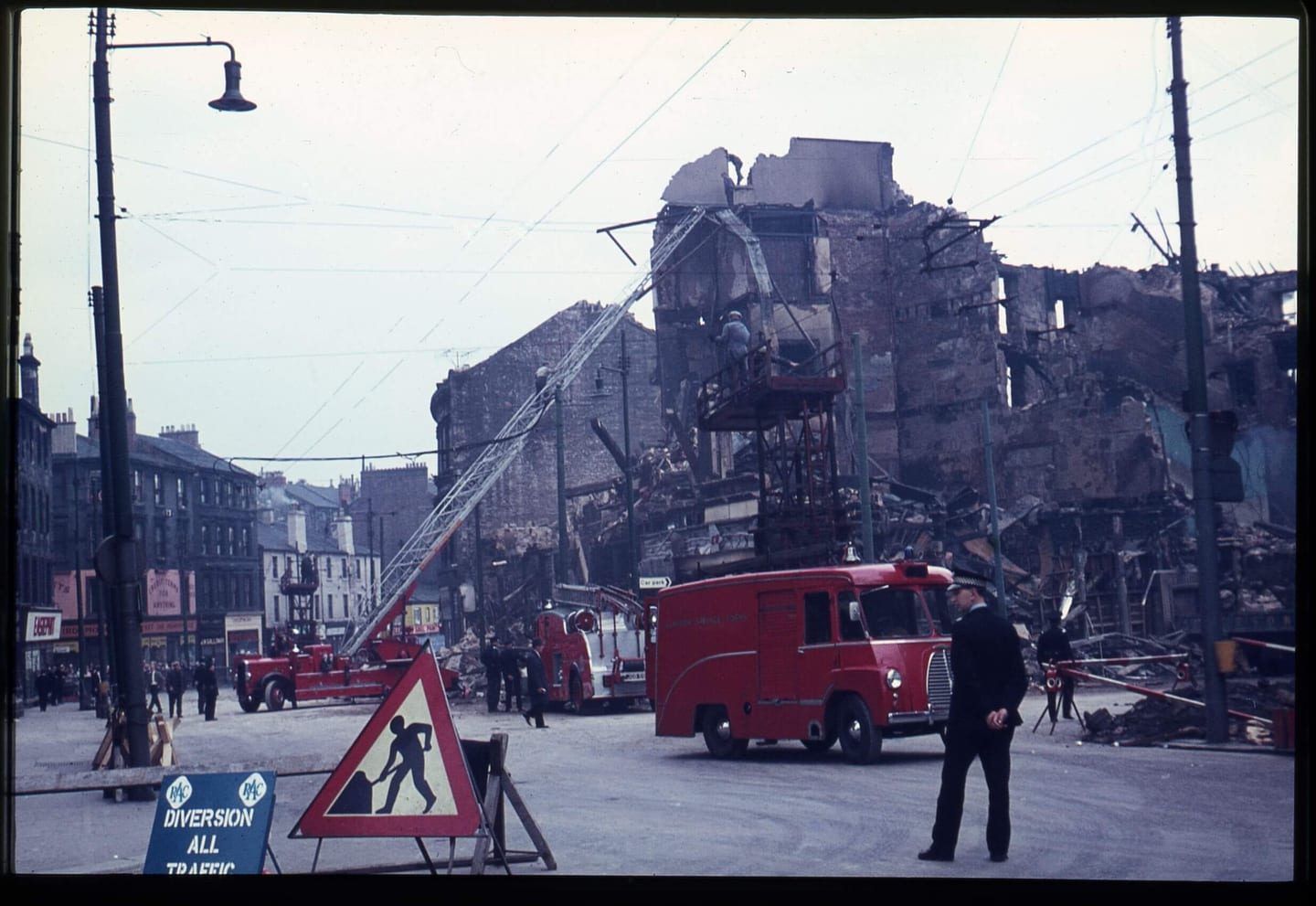
- Streets: 101 frames catalogued as the Chelsea Arts Club in the 1970s, New Bond Street in 1976 and a fire in the 1960s.
There are also 35 household folders, 20 of kitchenware and 11 of toys. Most of this is on 6 x 7 colour transparency film, and more than half of the archive has yet to be scanned. The inventory's wording is a research lead: with a few exceptions such as the street scenes, folders are not dated, and placing an object in a particular year means looking at the original.
Start with the corporate and technology collection and the folder of telephones, mobiles, pagers and fax machines, or search the full archive inventory. The London street photographs of 1976 are described in a separate article. When scans arrive, the free colour picker will read exact values from a wrapper or a telephone casing for a scenic artist to match.
Production designers, art department researchers and picture researchers can request professional access to discuss what a production needs.
Frequently asked questions
Where can I find 1970s reference photos for production design?
Use several kinds of source together: dated street and documentary photography for how places looked in use; mail-order catalogues, trade magazines and advertising for products and prices; museum object collections for exact models; and commercial studio archives, which hold clean colour photographs of telephones, packaging, toys, food and household goods taken when they were new.
How do art departments avoid anachronisms?
By dating every visible object separately. Each item has an earliest possible date: a product launch, a design change, a new coin. Anything introduced after the scene is set must go. Researchers then check the mix, because real rooms contain objects from the previous ten or twenty years as well as the newest things. Dated photographs are the evidence for both.
What telephones were used in Britain in the 1970s?
Rented Post Office instruments, hard-wired to the wall. The standard was the 700-series dial telephone introduced in 1959. The Trimphone, with its warbling tone caller and, on early models, a luminous dial, was available nationwide from 1968. Push-button Trimphones appeared in 1977. Customers could not buy a telephone and plug it in themselves until the new socket arrived on 19 November 1981.
Can I show an archive photograph on screen in a film?
Using a photograph for private research is different from reproducing it. If an image itself appears on screen, in a set dressing, a title sequence or a documentary, that is a use that normally needs a licence from the copyright owner, and other permissions may be relevant. Agree the intended use with the archive before relying on the picture. This is general information, not legal advice.
Why are studio product photographs useful as period reference?
Because they were made to show an object clearly: evenly lit, in accurate colour, with the label legible and often from several angles. Documentary photographs show the same object small, in shadow and half hidden. For a prop maker reproducing a chocolate wrapper or a set decorator matching the colour of a telephone, the product photograph is the more useful document.
Sources
- Trimphone (Wikipedia)
- British telephone socket (Wikipedia)
- Decimal Day (Wikipedia)
- Copyright notice: digital images, photographs and the internet, Intellectual Property Office, 4 January 2021
- The Sunday Times Magazine (Wikipedia)
- Robert Harper Photograph Library: archive inventory, Archive.London
Published by Archive.London. Corrections are welcome under our editorial policy.