
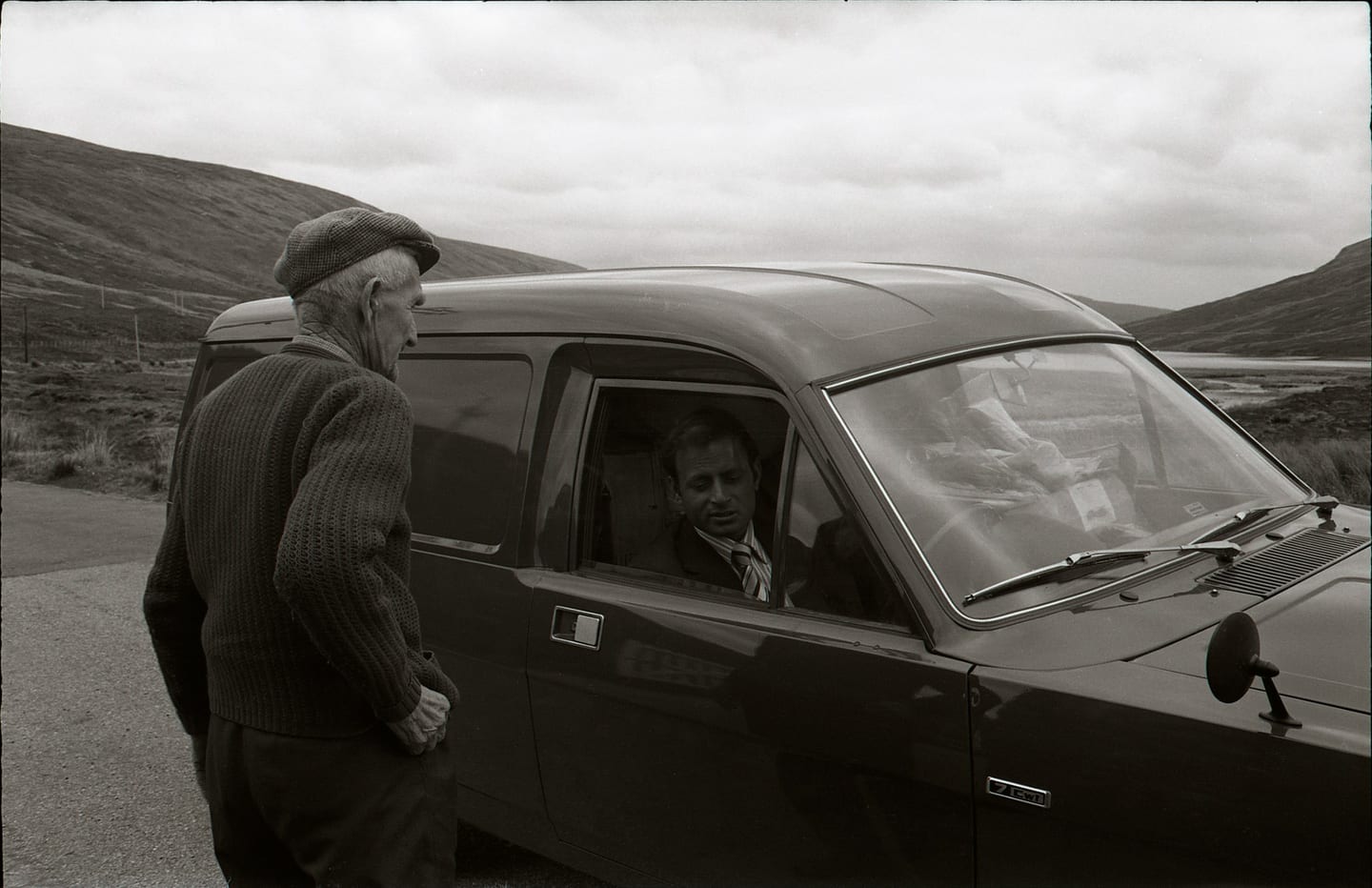
Counting fingers had a good run. People now identify AI images only a little better than a coin would, so the useful question has changed from what a picture looks like to where it came from.
A real photograph has neighbours: the frame before, the frame after, the sleeve it lives in. A generated one arrives alone.
You can no longer tell by looking, at least not well enough to rely on. When the Microsoft AI for Good Lab ran a "real or not" quiz, about 12,500 people made roughly 287,000 judgements and were right 62% of the time. The authors' own summary is that this is only slightly better than flipping a coin. Our angle follows from that number: once inspection fails, authenticity stops being a property you find in the pixels and becomes a property of the trail behind them. This piece ranks the checks that still work by what each one can actually prove, and ends with the oldest of them, which is asking to see the original.
The state of the tools described here was checked on 18 November 2026.
Can people still spot AI-generated images by eye?
The Microsoft study is useful because it is large and because it reports where people fail. Players did best on human portraits, where we all have a lifetime of practice, and worst on natural and urban landscapes, where there is no face to feel uneasy about. Of 193,779 judgements on generated images, 121,735 were correct, or 63%.
That result sits in a line of earlier findings. In 2022 Sophie Nightingale and Hany Farid reported in PNAS that participants distinguishing real faces from synthetic ones scored 48.2%, which is chance, and rated the synthetic faces as slightly more trustworthy. Those faces came from a generator that is now several generations old.
The familiar tells still exist: lettering that dissolves into near-writing, jewellery that merges with skin, reflections that disagree with the room, a crowd of faces that share one bone structure. They are worth a glance and no more. Each is a defect of a particular model at a particular moment, and defects get fixed. A method that only catches yesterday's generators is a nostalgia hobby.
Do AI image detectors work?
Better than people do. The same study reports that the lab's detector was right more than 95% of the time on both real and generated images, consistently across subject categories. The authors add the necessary caution themselves: detection tools will make mistakes too.
There are two reasons to hold a detector's verdict loosely. First, a classifier is trained on the output of known generators and may perform differently on a new one, or on a picture that has been resized, screenshotted and recompressed on its way to you. Second, the errors are not symmetrical in their cost. A detector that wrongly flags a genuine photograph can do real harm to the photographer who took it. Adobe's community forum for stock contributors carries threads from photographers who say their camera originals were rejected as generated. A score is evidence; it is not a finding.
What do Content Credentials and watermarks prove?
Two technologies try to settle the matter at the point of creation instead of after the fact.
Content Credentials are signed records attached to a file under the C2PA specification. A camera, an editing program or a generator can declare what it did and sign the declaration. Google's documentation says that Search may show such details in its "About this image" feature when the manifest was produced under version 2.1 or later of the specification and signed with a certificate on the C2PA Trust List. Our explainer on Content Credentials for photo archives covers the mechanics, and the Content Credentials checker will show whether a JPEG or PNG contains a manifest, without uploading it. It detects and displays; it does not validate the signature.
Invisible watermarks are signals woven into the pixels by the generator. Google DeepMind describes SynthID as designed to survive cropping, filters and lossy compression, and says its Detector portal, launched in 2025 and since opened to everyone, checks for marks from Google's own models and from partners including OpenAI, NVIDIA and Kakao.
Embedded labels are the plainest of the three. The IPTC's Digital Source Type field has a value, trainedAlgorithmicMedia, for media created with generative AI, and Google lists it among the values it reads. We explain the full vocabulary in IPTC Digital Source Type for scans, composites and synthetic images. An EXIF and metadata viewer shows what a file declares.
All three share one logical limit. A positive is meaningful: a valid credential or a detected watermark tells you something definite. A negative is nearly silent. Most genuine photographs have no credential. Metadata is stripped by many platforms. Watermark detectors only know the marks they were built to find, and a generator that applies none leaves nothing to detect. The Microsoft authors conclude that credentials and watermarks are "necessary to inform the public", which is right, and is not the same as sufficient.
Which checks are worth your time?
| Check | What a positive result tells you | What a negative result tells you | Fails when |
|---|---|---|---|
| Looking closely | Possibly an older or careless generation | Nothing | The model is recent |
| AI detector | Raised probability of generation | Lowered probability | The generator is new or the file has been reprocessed |
| Invisible watermark | Made or altered by a participating model | Nothing | The generator applies no mark the tool knows |
| Content Credentials | Who signed the file and what was declared | Nothing | Data was stripped or never added |
| Embedded metadata | What the file's maker declared | Nothing | Fields were removed, or filled in falsely |
| Reverse image search | Earlier appearances, original context and date | Weak evidence of novelty | The picture has never been published |
| Asking for the original | The photograph exists as an object or a raw file, in sequence | A reason for caution | The source is anonymous or unwilling |
Read down the third column and the pattern is plain. Only the last two rows give you much when the answer is no, and both are about history, not appearance.
How do you check where a picture came from?
Journalists call it verification, and picture researchers have always done it without calling it anything. The questions are old:
- Who published it first? Search for earlier copies. A photograph of a real event usually has a first appearance with a name attached, and often other photographs of the same moment from other positions.
- Who is the source, and can they be asked? A named photographer, agency or archive can answer questions. An account that appeared last week cannot.
- Does the claimed date survive contact with the content? Vehicles, signage, clothing and products all carry dates. We explore how badly generators handle this in why image models get the past wrong.
- Is there a sequence? Photographers do not take one frame. A real picture belongs to a shoot.
That fourth question is the one a generator has no answer to. A photograph made on film sits on a strip between two other exposures, often near-identical, and the strip sits in a sleeve with a label in somebody's handwriting. A digital photograph has a raw file with sibling files numbered either side of it. Producing a single convincing image is now trivial. Producing the dull, consistent surroundings of a real one is a different order of work.
What makes an original the strongest proof?
Competition organisers have already drawn this conclusion. World Press Photo's rules for its 2027 contest require entries in its main categories to be made with a camera, disqualify AI-generated images and generative fill outright, and treat AI enlarging tools as a breach because, in the organisation's words, they "introduce new information". Rules like these are enforceable only because the organisers can ask for the original file. The same logic runs through the published policies of picture agencies.
For film the original is a physical thing, and physical things carry evidence that is expensive to counterfeit: the emulsion, the edge markings, the mount, the dust of forty years. None of it is beyond forgery in principle. All of it costs effort, and it has to agree with everything else.
The digital equivalent is the camera raw file. It holds the sensor data before processing, together with the settings the camera recorded, and it sits in a numbered run with the rest of the shoot. A raw file can be fabricated by someone determined enough. A consistent card full of them, with the misfires and the test exposures, is a great deal harder, and asking for it costs a picture editor one email.
What can an archive offer that a detector cannot?
The Robert Harper Photograph Library is, among other things, a large quantity of this kind of evidence. Its inventory counts 52,684 unique analogue photographs but 134,340 analogue frames once duplicates and variants are included. Those extra frames are the neighbours: the alternative exposures and near-repeats that show a picture was made in a studio or a street on a particular day, as part of a job. The digital holdings include Nikon NEF raw files, the born-digital equivalent. The counts come from the inventory and have not yet been reconciled frame by frame, and more than half of the archive is still on film and has yet to be scanned.
We do not claim that provenance makes any use of a picture simpler in law; ownership, and what is and is not asserted about the people and brands depicted, is set out under rights and stewardship. The claim is narrower. When someone asks whether a photograph from this archive is a photograph, the answer can be a sleeve of transparencies.
Picture desks, publishers and researchers who need images whose origin can be shown, and not merely asserted, are welcome to start with the page for picture agencies.
Frequently asked questions
How can you tell if a photo is AI-generated?
Start with where it came from. Look for the earliest appearance with a reverse image search, check for Content Credentials and an invisible watermark, read the embedded metadata, and ask the source for the original file or film. Visual clues such as odd text or inconsistent shadows are worth noting but are now unreliable as a sole test.
Are AI image detectors accurate?
Good ones outperform people. The Microsoft AI for Good Lab reported a detector accuracy above 95% on its test images, against 62% for human players. But the authors also say detection tools will make mistakes, and accuracy on one set of generators does not guarantee accuracy on the next. Treat a detector score as one piece of evidence.
Can people still spot AI images by eye?
Barely. In the Microsoft study roughly 12,500 participants were correct 62% of the time overall, which the authors describe as only slightly better than a coin flip. People were most successful with portraits and least successful with landscapes. Earlier research on synthetic faces, published in 2022, found accuracy close to chance.
Does a missing Content Credential mean an image is fake?
No. Most genuine photographs carry no credential, and many platforms remove embedded data when a file is uploaded. A valid credential is positive evidence about who signed a file and what was declared. Its absence tells you nothing either way, which is why credentials work best alongside source checks.
How do you prove a photograph is real?
By producing what a generated image cannot have: the original and its context. For film that means the negative or transparency, its sleeve or mount, and the neighbouring frames on the roll or contact sheet. For digital work it means the camera raw file and the rest of the shoot. Dated records that predate the question add weight.
Sources
- Roca et al., How good are humans at detecting AI-generated images? Learnings from an experiment (Microsoft AI for Good Lab, arXiv 2507.18640)
- Google DeepMind: SynthID
- Google Search Central: Image metadata in Google Images (C2PA and IPTC Digital Source Type)
- IPTC NewsCodes: Digital Source Type vocabulary
- World Press Photo: What counts as manipulation (2027 contest)
- Nightingale and Farid, AI-synthesized faces are indistinguishable from real faces and more trustworthy (PNAS, 2022)
Published by Archive.London. Corrections are welcome under our editorial policy.